
Articles can be of several categories and of different genre, articles chiefly revolves around the audience or the readers. Knowing how to write an article has become very competitive and crucial on the internet.
Even though you know article writing and already have a brilliant theme and topic in your mind, you will notice that most of the themes and subjects have been formerly covered by all other internet users.
Then you will have to brainstorm topics and find out something exceptional and engaging which will not only convey a message to your audience but will create a sense of delight and satisfaction in them when they read your article.
Stats also claim that more than 90% of B2B Marketers consider Content Marketing the best strategy to connect with the audiences and Articles are the prime parts of this strategy.
What is an article?
An article is a written piece that provides information or news. It can be found in magazines, newspapers, online, and in other print media. How you write an article will depend on its purpose. Whether you’re writing to inform, entertain, or persuade, your goal should be to make your readers engaged with your writing.
Here are some tips on how to write an effective article:
Start with a strong hook. The first sentence of your article should grab the reader’s attention and make them want to read more.
Write in a clear and concise manner. Be sure to get your point across without using too many words.
Use strong verbs and an active voice. This will make your writing more engaging.
Use quotes and real-life examples. These can help to illustrate your points and make them more relatable to your readers.
Edit and proofread your article before you publish it. This will ensure that it is free of any errors or typos.
Following these tips, you can write an effective article that will engage and inform your readers.
Objectives of Article Writing
The main objective of article writing is to communicate a message to the reader. However, there are other objectives that you can keep in mind as well, such as:
- To promote a product or service
- To increase brand awareness
- To generate leads
- To build an audience
- To establish thought leadership
With these objectives in mind, you can tailor your article accordingly. For example, if you’re looking to generate leads, you might want to include a call-to-action (CTA) at the end of your article.
If you’re looking to build an audience, on the other hand, you might want to focus on publishing articles that are helpful and informative.
No matter what your objectives are, though, always remember to keep your readers in mind. Write for them, and not for yourself.
When it comes to article writing, there are no hard and fast rules. As long as you keep your reader in mind, you can experiment with different formats and styles to see what works best for you. So don’t be afraid to experiment, and happy writing!
Steps of Writing an Article
Select a topic to write about:
The first step in writing an article is to select a topic. You can write about anything that you think would be of interest to your target audience. When selecting a topic, consider what you want to achieve with your article. Are you looking to inform, entertain, or persuade? Once you’ve selected a topic, do some research to gather the information that will help you write your article.
Identify your target audience:
Before you start writing, it’s important to identify your target audience. Who are you writing for? This will help determine the tone and style of your writing. For example, if you’re writing for a medical journal, you’ll need to use a more formal tone than if you were writing for a lifestyle magazine.
Research facts that reinforce your story:
Once you’ve selected a topic and identified your target audience, it’s time to do some research. Gather information that will help support the points you want to make in your article. This can include statistics, quotes from experts, and real-life examples.
Come up with an outline of your article:
After you’ve gathered all of your information, it’s time to start putting together an outline of your article. What are the main points that you want to make? How can you best organize your thoughts? Once you have a rough idea of what you want to say, you can start filling in the details.
Write a rough draft and pare down your outline:
Now it’s time to start writing. Don’t worry about making everything perfect at this stage – just get your thoughts down on paper. Once you have a rough draft, you can start cutting out any unnecessary information. This will help you focus on the most important points that you want to make.
Specify your subject matter:
When you’re revising your article, make sure to specify your subject matter. What are you trying to say? Be clear and concise in your writing.
Read aloud until your draft is error-free:
Once you’re happy with your article, it’s time to proofread it for any errors. A good way to do this is to read your article aloud. This will help you catch any typos or grammatical errors. Once you’ve corrected any mistakes, your article is ready to be published!
Role of Articles in Content Marketing
Articles are a versatile and powerful tool that can be used for many different purposes. As we mentioned before, they can be used to inform, entertain, or persuade your readers. But how can articles be used in content marketing?
Articles can be a great way to generate leads. If you include a CTA at the end of your article, you can encourage your readers to take action. This could be signing up for your newsletter, downloading a white paper, or even making a purchase.
Articles can also help you build an audience. By publishing helpful and informative articles, you can position yourself as an expert in your field. This will make people more likely to return to your site in the future, and it may even lead to them sharing your articles with their friends and followers.
Finally, articles can be used to drive traffic to your website. By optimizing your articles for SEO and promoting them on social media, you can attract new visitors to your site. This is a great way to grow your business and reach new customers.
Format of Article Writing
Now that we’ve gone over some of the basics of article writing, let’s take a look at the format. How should you structure your article?
There are a few different things that you’ll need to include in your article:
A catchy headline:
The headline is one of the most important parts of your article. It’s what will first catch your reader’s attention, so make sure it’s interesting and informative.
An introductory paragraph:
The intro is your opportunity to hook your reader and give them an overview of what your article is about. Be sure to include any relevant background information.
Body paragraphs:
The body of your article is where you’ll make your argument or present your information. Each paragraph should focus on one main idea.
A conclusion:
The conclusion is your last chance to make an impression on your reader. Sum up your main points and leave your reader with something to think about.
A call to action:
As we mentioned before, you can use your article to generate leads by including a CTA. This could be a link to your website, a form to fill out or even a discount code.
When it comes to Content Marketing, immaculate inclusion of the right SEO strategy and quality Articles is considered the best organic strategy to optimize the online presence of businesses. Let us understand why SEO Compatibility of articles is significant-
Importance of SEO Compatibility in Article Writing
In this age of competition, it also becomes important to understand how the playfield and the competitors actually work. Going by the analysis that you do on the competitor, it doesn’t take long to find that they rely on Search Engine Optimisation.
It is something that has surely gained a great deal of popularity. You should always try to write an article that is SEO friendly.
Search Engine Optimisation, in a nutshell, is a method of enhancing the effectiveness and the efficiency of the content; you wish to share with the users for the search engines. It is basically done to rank higher in the search results.
Now, this statement doesn’t demand any justification or explanation. Ranking higher is the main thing that is directly proportional to the traffic you get on your website. You just have to start by researching the keywords and then choose one. You have to write a quality article keeping that keyword in context and all this makes it an SEO-friendly article.
However, despite Search Engine Optimization being a significant factor in internet marketing, the quality of content is the deciding factor behind the profitable performance of an article.
This article will give you a profound and complete idea of how to write an article with top-notch quality.
The entire Internet business depends on articles and if you master the way how to write an article without any difficulty or dilemma, it is going to be extremely beneficial for you and the creative writer in you.
Shaping your theme with the way you write and what you think is going to create an exceptionally effective outlook for your audience-
Shaping the theme of your Article
Even if you know how to write an article you will also have to put in a lot of effort in deciding the subject and the theme of the article. Few article kinds are best suited to certain subjects; let us see a few article topics mostly written upon-
Elementary Article – where information is passed on to the audience in a more imaginative and original way.
In what ways – articles like these tell the readers in what ways or how a job or an assignment is carried out, completed, and achieved.
Sketch, outline, or biography – these articles include knowledge and material about an individual which is created by absolute history and by extensive communication with the distinct being.
Let us have a look at some of the tips on Article Writing-
Tips on How to Write an Article
1. Know Why are you writing this article
A gesture or a sign which is neglected or ignored by society or the masses.
What message or information do you want to convey through your article?
For example, if you are writing about a company which produces travel goods, what would you emphasize more on? The products or their uses when traveling.
2. To write an article you need to make your paragraphs crisp and brief
You definitely need to be concerned about the property and attribute of your article, but also in the meantime, you don’t want your article to be read as a prolonged piece of content.
You need to attract a lot of attention from your audience; hence it should be factual, informative but competent, and sufficient.
3. Article should carry a lot of essence and matter
The worst article will be if it does not include substance and matter in it.
It should be noticeable enough to the readers. Contents need to be ideated in a way to educate and deliver sense and purpose.
The structure and arrangement of articles –
(i) Theme of the article
(ii) Author’s name
(iii) Soul of the article
(iv) Outcome of the article.
4. Study articles of famous and well know people
On the internet, you will find in numerous articles written by famous and universal writers, who pen down appealing phrases whenever you see or hear them.
5. Try to get as many inspirations as possible

Research and produce records of probable topics that you think would interest you to write articles on. You need to know what inspires you to write an article.
6. Try to select a topic that you are fond of
Nothing can be more appealing to the readers if you are enthusiastic and highly spirited about the topic.
Your passion and enthusiasm will reflect highly on your article, but not always you will be able to write articles which will be a topic or subject of your interest, but still try to find some exceptional substance in it which inspires you to research thoroughly.
It has been evident in most cases that people tend to ignore the importance of researching when they are writing about a topic they are familiar with.
This practice might seem time and effort-saving but surely would have an adverse effect on your readers as passing some information without researching can surely impact their trust and loyalty.
7. Conduct exploration and research about your theme or topic
To learn how to write an article it is very important to know the advantages and disadvantages of the selected topic you are writing on.
You can use resources and take information about a topic from a book and do an extensive analysis and investigation on those topics. Your resource can be taken from anywhere for example- books, movies, documentaries, sports tournaments and many more.
You will also find a variety of knowledge and information on the internet if researched in a proper manner.
8. Refine and question your own topic and discussion
When you write something and also write the mistreatment of the very same topic, it catches more and more attention of the readers.
You may even try and make mention your previous article on the same topic so that users become familiar with you and the website.
This also goes a long way in establishing backlinks and allowing the users to take a tour of all the information you have to offer.
9. Implement your article only with reputable and authentic roots
Whenever we think of authenticity, the first thing which comes to our mind is newspapers.
Newspapers can be a very useful and authentic root for researching the article you want to write.
Or you can find any other authentic roots from trustworthy resources as well. You will find the authenticity of your resource if you keep a few things in mind such as-
(i) Data and Figures
(ii) Citations, extracts, and passages of popular people.
(iii) Characterization
(iv) Episodes (crisp tales about an individual or yourself)
(v) Statement of movies, print media, etc.
Having said that, always try and check whether the figures that you have collected and are eventually planning to use are correct and trustable or not.
This might seem like a time-consuming process, but is surely an excellent practice that can be inculcated while writing an article.
10. Build your article up in a more distinguishing way
Cross-check each relevant trail in your article, if your article is lengthy divide it into many specks. Juxtaposing complex knowledge will attract the attention of your readers highly.
11. Take care of your readers’ requirements
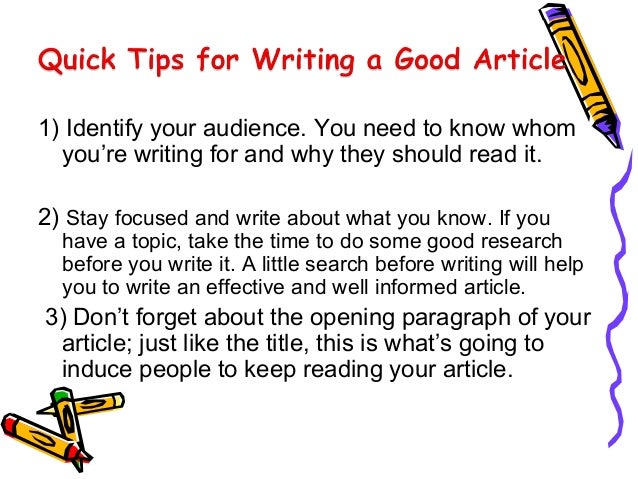
Picture yourself as the reader and think about what the reader requires from your article; make a note of all the benefits and information you will gain as a reader from the article.
The titles of your topic- The titles of your topic should be eye-catching, and crisp, and should provide enough information to the readers about the topic.
12. Knowing your topics and themes
When you are done with extensive research for writing your article try to make an index of your article.
13. Discover an uncommon twist for your Article
The moment you have simplified your topic and reduced it to one form it is the time for you to know how you can build your article to be distinct and prominent.
14. Avoid copying any other person’s work
Plagiarism should be refrained from use in an article, even if you take facts and advice from other articles you should be well aware of how to accumulate that information.
15. Determine the proportion of your Article
Your article does not need to be lengthy to convey strong and impactful messages, you might sometimes also have to work according to certain word limits and length you should work tactfully with these parameters.
While writing the article, you need to follow certain parameters to write an article that would answer the question in your mind about how to write an article-
How to write Articles by Following a Structure

To understand how to write articles that ensure the expected outcomes, paying attention to the proper structure of the article is also significant here. Let us have a look on that as well-
Introduction- Start with a prominent beginning explaining the further article.
Chase your Subject- When you have compiled your article into narrower aspects follow that aspect throughout your article, this will help you to move further with your article.
Apply suitable Framework- The audience who is reading your article definitely does not know as much about the subject of your article as you do. Try to put in circumstantial advice for your readers.
Demonstrate your article with a Proper Picture- Try to put detailed and vivid information to give your readers a good understanding of your article.
Introduce your own Style and Trait- When you are writing an article you would definitely want to introduce your signature style and trait, this would help the readers to know about you and understand your signature style when they read your article. This would increase a lot of respect towards you from your readers.
Write a Great Ending- If you started your article with an episode you should reopen it in your ending. Endings are mostly concrete when you use an example, giving your audience a vision to think forward.
Using additional information- Try to give your audience additional written or graphical matter
Including pictures, statistics and additional data would help to keep the reader’s attention active and uninterrupted and that is why most of the guides on How to Write Articles suggest this tip.
Your article writing needs to be attractive, bright, and comprehensible.
Revising your work- Revise your work and read it to yourself for corrections and other grammatical errors, and remove additional and conflicting information. Rewrite paragraphs and episodes as necessary.
Give your article to someone else for reading- When you give your article to trustable friends or relatives of yours, ask them questions like, whether they like your article? Do they understand the points you are trying to make etc.
One such important concept can also be of copywriting. Paying attention to this will also be quite helpful in composing impressive articles for your audiences.
Role of Copywriting when you Write an Article
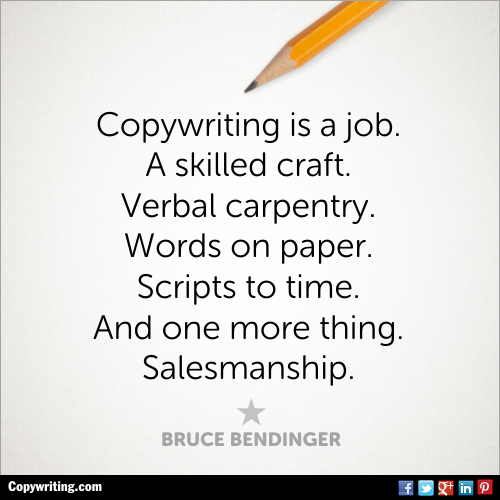
Many people often mistakenly end up perceiving that copywriting is a hard task.
The following brief explanation surely impressed the task to break the hoax of copywriting being a head concept.
It is basically related to the creation of such content that eventually induced the reader to buy a product or induces them to indulge in something that you want them to. This can be anything from a single click to making them try your offers or services.
Any person can scale the possibility of being a professional copywriter by developing their writing skills. A copywriter can be anyone, be it a marketer or even a freelance writer.
In Conclusion…
In the end, keeping all these tips and the information shared in context surely goes a long way in helping you deliver an exceptional article.
Again, SEO should never be put out of context. Google is the main thing behind the success of your article and the audience it reaches. It simply determines the relevance of your article by analyzing the content it holds on various factors.
Quality is the king and this should not only be kept in context but should also be followed religiously.
You should also have complete knowledge about the article writing format.
Joining SEO Course would help you learn and master how to write an Article like a pro.
FAQs
Question – What are some tips for writing a good article?
Answer – Here are the tips for writing a good article –
- Start with a catchy headline.
- Write an introductory paragraph that gives your reader an overview of what your article is about.
- Make sure each body paragraph focuses on one main idea.
- Sum up your main points in the conclusion.
- Include a CTA to encourage your reader to take action.
Question – How can I promote my articles?
Answer – There are a few different ways that you can promote your articles:
- Share them on social media.
- Include links to them in your email signature.
- Submit them to article directories.
Question – How long should my article be?
Answer – The length of your article will depend on your purpose and audience. In general, shorter articles are better for generating leads, while longer articles are better for building an audience and driving traffic to your website.
If you’re just starting out, we recommend keeping your articles to around 500 words. As you get more experienced, you can experiment with different lengths to see what works best for you and your readers.
Question – How often should I publish articles?
Answer – There’s no hard and fast rule for how often you should publish articles. It depends on your goals and your audience. If you’re looking to build an audience, we recommend publishing new articles on a regular basis. This could be once a week or even once a day.
On the other hand, if you’re just trying to generate leads, you may not need to publish articles as frequently. Once or twice a month may be sufficient.
The best way to figure out how often you should publish articles is to experiment and see what works best for you and your readers.
Question – What are some common article writing mistakes?
Answer– Here are some common article writing mistakes –
- Some common article writing mistakes include:
- Not proofreading your article before publishing it.
- Forgetting to include a CTA.
- Publishing articles that are too short or too long.
- Failing to promote your articles after they’re published.