

Due to the advancement of the internet penetration rate digital media users are increasing. Businesses are interested in building online brands to catch consumer attention. Reasonably, learning various internet marketing skills and jobs is a huge competitive advantage. According to Statista, the colossal growth rate of digital marketing will reach up to INR 539 billion by the year 2024.
The scope of digital marketing industry in India is on the rise, with the market attaining a value of USD 5,118.55 million in 2023 (INR 425,930.356 million) and further expected to grow at a CAGR of 30.3% to reach USD 55,372.78 million (INR 4,603,994.497 million) by 2032.
The Digital India initiative started by the government has been a motivating factor in making even small business owners aware of the power of online marketing techniques.
The Digital India initiative (by the government) has been an adapting factor for small businesses.
Another reason for the growth of the digital marketing landscape is the improving internet penetration across the country, with broad expansion through initiatives such as BharatNet.
Initiatives such as BharatNet are improving internet penetration and the whole digital landscape.
Businesses like Airbnb, Spotify, GoPro, CultFit, and Nike have understood the power of social media marketing, paid media, email marketing, and search engine optimization to gain more customers.
According to Demandsage, digital advertisements can increase a brand’s awareness by 80%. Not only this, revenue from email marketing is worth $8.49 billion (706.7088 billion) as of 2024.
Even 93% of businesses are active on Facebook, and 86% also take advantage of Facebook advertising according to WordStream.
Traditional jobs and businesses are adapting to online employment and marketing strategies. The absence of online marketing strategies and skills can surely hamper the growth of a brand and limit the opportunities to gain more reach and customers.
According to Economic Times, India registered 72,993 startups that created 7.68 lakh jobs in past six years.
By 2027, freelancers are expected to constitute over half (51%) of the US workforce, becoming the majority.
Hence, Practicing online marketing skills is a game-changer in terms of professional development and career establishment.
In this blog post, we will see the growing scope of digital marketing insights along with the career opportunities using data, market, and company behavior.
What is Digital Marketing?
According to MailChimp, “Digital marketing, also called online marketing, is the promotion of brands to connect with potential customers using the internet and other forms of digital communication. This includes not only email, social media, and web-based advertising, but also text and multimedia messages as a marketing channel.
Essentially, if a marketing campaign involves digital communication, it’s digital marketing.”
Digital marketing applies the fundamental principles of traditional offline marketing, but it operates within the digital realm. It depends on consumer data to identify a business’s target audience and convey highly pertinent messages.
While this approach proves effective, the prevalence of digital marketing has led to the primary challenge of distinguishing oneself amid the multitude of digital content and strategies in use today.
So, digital marketing can be defined as the online marketing of the products and services of any particular company that has been established. This can be used with the help of mobile devices and so much more.
We all know that there is a pretty common challenge that businesses have to face these days. Getting the attention of the audience and people to whom they want to appeal is not that easy. Hence, the importance of digital marketing is increasing day by day for sure.
Scope of Digital Marketing in India 2024: Stats and Insights
Now that you know how important digital marketing is, you are all set to know the scope that it has in the country for sure.
Across India, the market size of the digital advertising industry was around 47 Billion in 2015. It went up to INR 116.3 in 2018, and in the 2020 financial year, it reached INR 199 billion.
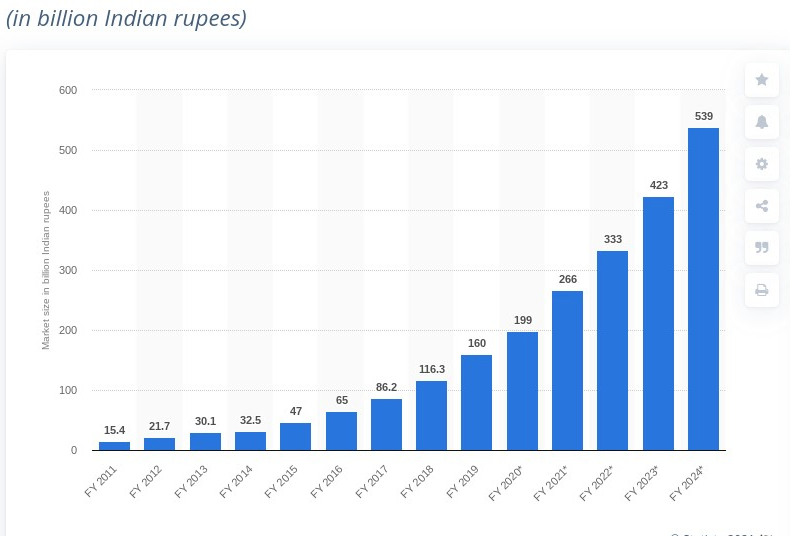
- According to Statista, a colossal growth of digital marketing will make it hit and create a market of up to INR 539 billion by the year 2024.
Some other trends also suggest that Digital media is expected to grow with a CAGR of 22.47 percent to reach INR 23,673 crores by 2023 end.
All these statistics reveal that a vast amount of money is injected into all digital channels. As a result, the activities of digital marketing are used immensely.
For conducting all the activities fluently, the industry requires skilled experts to do that. These positive statistics show an inspiring career in digital marketing.
We can safely say without any doubt why just India- Digital marketing is doing a lot well in the amazing parts of the world for sure.
We all know that our country is currently going digital and there has been a lot of change in marketing methods as well.
The population of youth in India is humungous, and in addition to this, every day today is associated with social media. Thus, targeting the Indian audience through digital marketing channels is easy and more beneficial.
With the initiative of “Digital India” proposed by the Prime Minister of India, more and more jobs are oozing out for the youth to make this initiative a success.
With the help of the latest developments, the scope of digital marketing in India has increased.
Career Opportunities in Digital Marketing in India in 2024
With the advancement of digital marketing, careers in this arena are flourishing a lot. The sphere of digital marketing careers is high these days.
In the portal, Naukri.com says around 21,873 jobs in the genre of digital marketing are available. There is no doubt a cheerful number of job availability in India. So it’s safe to select a career in digital marketing.
Is Digital Marketing a good career option in India?
Two of the key deciding factors are the handsome salary packages and exponential career growth opportunities.
Here it is important to understand that the professionals who opt for Digital Marketing Career enjoy a better salary package compared to other career options.
Below you can see the approximate range of Digital Marketing salaries :
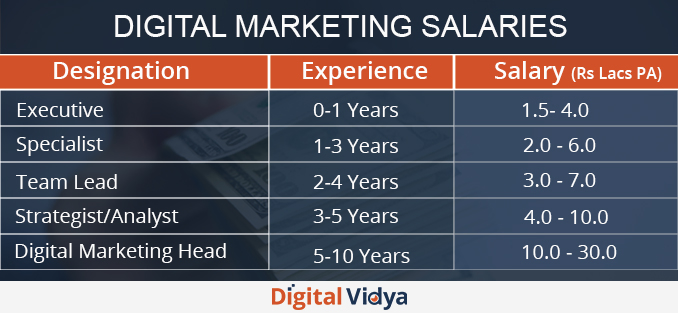
In addition to this, the salary package of Digital Marketing Experts with exceptional educational backgrounds (e.g. IIT/IIM) or professional experience who are in the senior position at the high growth startups may go beyond INR 1 Crore annual salary.
Who should opt for a Digital Marketing Career?
The digital marketing industry offers various career options to persons who have particular subject interests. It has something or the other for every person.
For example, if a person’s passion and love are social media, then that person may choose to become a social media marketing expert. On the other hand, if a techie is captivated by coding, becoming a web developer is the best option.
Choices are abundant for people who have a longing for a creative field. Content writing can be a good option for those who have strength in writing.
If someone is interested in the design genre, a career in graphic design is the best choice for them. People with analytical minds can become Data analysts.
Digital Marketing Skills In Demand
Digital Marketing is about communicating with your audience, understanding what resonates with them, and delivering that content to them in the best possible way.
Digital marketers just don’t ask the audience to buy a product or service. But they also work towards building a relationship with them.
LinkedIn says digital marketing specialist is one of the in-demand career options boasting a large number of 8,60,000 job openings.
Learning the top digital marketing skills will help you become a better digital marketer and prepare you for the job market.
Around 93% of all online communication and interaction begins through search engines. It shows how much the necessity of SEO-friendly content is there, which will help it rank well on Google and other search engines.
Ranking websites at the peak of all the search engines organically and through paid means are a good form of advertising for businesses. If a person is proficient in skills such as SEO and SEM, it can elevate the site’s ranking on all search engines.
Some of the demanding digital marketing skills are :
1. SEO (Search Engine Optimization):
- SEO involves optimizing website content to rank higher in search engine results.
- Key skills include keyword research, on-page optimization, and understanding search engine algorithms.
2. SMO (Social Media Optimization):
- SMO focuses on optimizing social media profiles and content for better visibility.
- Skills include social media strategy, content creation, and community engagement.
3. SMM (Social Media Marketing):
- SMM involves using social media platforms for marketing purposes.
- Skills include creating and implementing social media campaigns, analytics, and audience engagement.
4. Paid Media:
- Paid media involves advertising on various digital platforms.
- Skills include understanding ad platforms, budget management, and campaign optimization.
5. Video Production and Marketing:
- Involves creating and promoting video content.
- Skills include video production, editing, and understanding video marketing trends.
6. Data Analytics:
- Analyzing and interpreting data to make informed marketing decisions.
- Skills include data interpretation, statistical analysis, and proficiency in analytics tools.
7. Content Marketing:
- Focuses on creating and distributing valuable content to attract and engage a target audience.
- Skills include content creation, storytelling, and understanding audience needs.
8. Graphic Design:
- Designing visual elements for digital marketing materials.
- Skills include graphic design software proficiency, creativity, and an eye for aesthetics.
9. Pay-per-click (PPC):
- Involves running paid advertising campaigns where advertisers pay a fee each time their ad is clicked.
- Skills include keyword research, ad creation, and campaign optimization.
10. Inbound Marketing:
- Attracting and engaging customers through valuable content and experiences.
- Skills include content creation, SEO, and lead nurturing.
11. Conversion Rate Optimization:
- Focused on increasing the percentage of website visitors who take a desired action.
- Skills include A/B testing, user experience optimization, and data analysis.
12. Growth Hacking:
- Innovative and rapid experimentation to identify the most effective ways to grow a business.
- Skills include creativity, data-driven decision-making, and a strategic mindset.
13. Business Analytics:
- Analyzing business data to drive strategic decisions and achieve organizational goals.
- Skills include data analysis, problem-solving, and business acumen.
These skills collectively contribute to a well-rounded digital marketer capable of navigating the dynamic landscape of online marketing.
Digital Marketing Jobs
If you are concerned about the job that you are going apply for after doing some amazing courses on digital marketing, we can assure you that you don’t have to worry.
The scope of a digital marketing course is such that people can have so many amazing job opportunities.
There are options for people to become digital marketing specialists for the company.
You can also choose to become an SEO expert. There are some other marketing jobs that you can also apply for and that too online.
Doesn’t that seem like such an amazing idea? With the help of digital marketing, you will be welcomed into a new world.
A world that is filled to the brim with possibilities and options that you can try out for yourself.
Not to mention that you are going to have a pretty high income as well.
Professionals who deal with digital marketing services have a pretty hefty income.
So, the future is set for those who want to practice the amazing tips of digital marketing in the best way. We are here to tell you that if you choose to do that then you are going to be one of the luckiest people for sure.
Top Career Options in Digital Marketing
The digital marketing industry offers standard career opportunities not only for professionals but also for freshers. Have a look at the positions:
1. Digital Marketing Manager
A digital marketing manager formulates and executes the digital presence of a business. They promote the product and services of a brand to increase sales in a cost-effective way.
The responsibilities of the Digital Marketing Manager are:
- Managing marketing team
- Reporting to VP or head
- Planning events and campaigns for digital marketing
2. Search Engine Optimizer
A search engine optimizer deals with SEO and analyzes, reviews, and optimizes websites with organic techniques of SEO. Developing content with positive and relevant keywords for elevating website traffic is a skill of Search engine optimizers. One must remain updated about the latest trends and changes in search engines.
- Choose and integrate strategic keywords for improved search rankings.
- Enhance meta tags, headers, and content for SEO effectiveness.
- Acquire quality backlinks to boost website authority and credibility.
3. Social media marketer
Social media marketing is about managing a brand’s digital presence in social media platforms like Facebook, Instagram, etc. A social media marketer is an expert in designing and implementing a social media strategy for a business. What a social media marketer does are:
- Builds content according to a strategy
- Posts the content
- Track the metrics such as reach, like, and impressions.
4. Search Engine Marketing
Search engine marketing experts take care of the paid ads throughout the search engines. One possessing analytical skills can choose this career option. SEM experts implement the following:
- Ad campaigns
- budgets
- Targeting
- Bidding
- Writing spellbinding copies
5. Content Marketer
Content is the king of digital media. Content marketing requires creating content for the digital world.
Content creation can be done in the following forms:
- Videos
- Articles
- Blogs
- Email newsletters
- Social media content
Some other career opportunities in digital marketing are:
- Email marketer
- Content creator for Virtual reality and augmented reality
- SEO experts for Voice assistants
- automation specialist
- Paid media expert
- Web developer
- Data Analyst, etc.
| Job Role | Required Skills | Salary Range (INR) | Experience Level | Company Size | Industry |
| Digital Marketing Manager | SEO, SEM, Social Media Management, Analytics | 8,00,000 – 15,00,000 | 5+ years | Medium to Large | E-commerce, Marketing Agency |
| SEO Specialist | Keyword Research, On-Page Optimization, Analytics | 4,00,000 – 8,00,000 | 2-5 years | Small to Medium | Digital Marketing, IT |
| Content Marketing Specialist | Content Creation, Strategy, SEO | 6,00,000 – 10,00,000 | 3-7 years | Small to Large | Publishing, Technology |
| Social Media Manager | Social Media Strategy, Content Creation, Analytics | 5,00,000 – 9,00,000 | 3-6 years | Small to Medium | Advertising, Entertainment |
| PPC Specialist | Pay-Per-Click Advertising, Analytics, Bid Management | 5,50,000 – 10,00,000 | 3-8 years | Small to Large | Advertising, E-commerce |
| Email Marketing Specialist | Email Campaigns, Automation, Analytics | 4,50,000 – 8,00,000 | 2-5 years | Small to Medium | Retail, E-commerce |
| Analytics Manager | Data Analysis, Reporting, Visualization | 8,00,000 – 15,00,000 | 5+ years | Medium to Large | Finance, Technology |
| Digital Marketing Intern | Basic Knowledge, Eagerness to Learn | 2,00,000 – 4,00,000 | Internship | Small | Any (Training Program) |
Current State and Opportunities of Digital Marketing in 2024
The year 2024 is witnessing unprecedented advancements in technology, particularly in artificial intelligence and machine learning.
World Summit AI’s research indicates that by 2035, the integration of AI could elevate the average profitability rates of the marketing industry by 38%.
This integration is projected to contribute to substantial economic growth, reaching $14 trillion.
With the proliferation of social media platforms and interactive content, digital marketing has evolved to become more engaging and customer-centric.
Keeping the high engagement rate in view, according to Statista, the social media advertisement market is expected to reach US$219.8bn in 2024.
However, marketers must stay agile and adapt their strategies to algorithm changes, which can sometimes lead to fluctuations in reach and engagement.
With the constant bombardment of digital content, there’s a risk of digital fatigue among consumers. This could result in decreased engagement and receptiveness to online marketing efforts.
Marketers need to strike a balance between frequency and quality of content to avoid overwhelming their target audience.
To understand the scope of digital marketing in depth, let us take a look at how digital marketing opportunities present themselves for various audiences such as students, entrepreneurs, and working professionals as well.
Scope of Digital Marketing for Students, Entrepreneurs, and Working Professionals
Digital marketing offers students a vast and optimistic scope, providing a plethora of opportunities and avenues for growth. In today’s Internet marketing world, digital marketing has become a powerhouse, influencing how businesses reach and engage with their audiences.
As we delve into the various aspects of the scope for students in digital marketing, we’ll explore the diverse career paths, skill development, internship, and freelancing opportunities, potential for entrepreneurial ventures, the importance of continuous learning and adaptation, the global reach and remote work possibilities, industry collaboration and networking, and the significance of certifications and specializations.
This multifaceted landscape not only promises exciting prospects but also encourages students to chart their course in a field that thrives on innovation, creativity, and strategic thinking.
1. Diverse Career Paths
Scope: Digital marketing offers a plethora of career paths, allowing students to specialize in areas such as SEO, social media marketing, content creation, email marketing, analytics, and more.
According to Naukri.com, as of January 2024, there are 1,50,987 jobs available in the digital marketing domain. The job roles are wide and diverse. Some of the job roles available are:
- Digital Marketing Manager
- SEO Specialist
- Social Media Manager
- Content Marketing Manager
- PPC/SEM Specialist
- Email Marketing Specialist
- Analytics Manager
- Web Developer
- Graphic Designer
- E-Commerce Manager
Being a digital marketing training provider, we have placed candidates all over the digital marketing domain. Some of our placed students in diverse job roles:
- Shivam Tripathi – Performance Marketing Executive
- Nikhil Patel – Digital Marketer
- Sandeep Vethia – Social Media Executive
- Muskan Khurana – Content Writer
- Varuna Anand – Digital Marketing Consultant
- Shubham Dev – Lead Data Analyst
2. Skill Development
Scope: Digital marketing provides students with an opportunity to develop a versatile skill set, including data analysis, content creation, social media management, and marketing strategy.
The skill development leads to better career opportunities in the fields related to digital marketing such as social media marketing, search engine optimization, inbound marketing, influencer marketing, analytics, content marketing, and many more.
One of our students Revant Vyas, who is a photographer by profession, gained digital marketing skills to boost his website and gain more customers for his photography firm. Being an entrepreneur he wanted to grow his photography firm by reaching out to a wider audience.
3. Internship and Freelancing Opportunities
Scope: As businesses increasingly invest in influencer marketing, students can secure internships in SEO, social media, content writing, influencer relationships, ad other digital marketing domains. According to a report by Influencer Marketing Hub, businesses generate $5.20 in earned media value for every $1 spent on influencer marketing.
Students can assist in influencer campaigns, measuring their impact and contributing to the brand’s online presence.
Shambahvi Tiwari, a fresh graduate and a student of the CDMM Course, is currently working as an SEO intern, thereby gaining essential skills and knowledge for further career progress.
4. Entrepreneurial Ventures
Scope: Social media platforms have become pivotal for small business promotion. According to a survey by Hootsuite, 73% of marketers believe social media marketing has been “somewhat effective” or “very effective” for their business.
Entrepreneurial students can utilize social media marketing to create brand awareness and drive sales for their startup ventures.
5. Continuous Learning and Adaptation
Scope: The rise of AI in content creation emphasizes the need for marketers to stay ahead. A study by PwC reveals that AI is expected to contribute over $15 trillion to the global economy by 2030.
Students can explore AI-driven content creation tools, adapting to technological advancements for more efficient and personalized marketing strategies.
6. Global Reach and Remote Work
Scope: The remote work trend in digital marketing is on the rise. Buffer’s State of Remote Work 2023 report indicates that 98% of respondents want the option to work remotely for the rest of their careers.
Students can collaborate with international clients, leveraging digital marketing to bridge geographical gaps and work with diverse teams.
7. Industry Collaboration and Networking
Scope: Virtual events are becoming increasingly popular. A survey by Bizzabo found that 80% of marketers believe virtual events are here to stay even as in-person events return.
Students can attend virtual marketing conferences, connecting with professionals worldwide and gaining insights into the latest industry trends.
8. Certifications and Specializations:
Scope: Certifications in conversational marketing platforms are gaining prominence. According to Drift’s 2024 State of Conversational Marketing report, businesses using conversational marketing see a 62% increase in qualified leads.
Students obtaining certifications in chatbot development can enhance their expertise, contributing to the growing field of conversational marketing.
Certifications from Google, Hubspot, Facebook, and LinkedIn prove the student’s credibility thereby building authority and gaining more relevant and rewarding job opportunities.
How to start a career in Digital Marketing in India
If one plans to start a career in digital marketing, it is easy to do that. You can follow the following steps to begin a rewarding career in digital marketing.:
Step 1: Register for a digital marketing course
A little bit of technical knowledge and the ability to communicate and calculate the aftermath of campaigns can help you receive the best knowledge in this arena. Online courses and offline courses are available to register and start learning digital marketing.
Step 2: Get knowledge and Experience through Internships
There is no substitution for an internship. It is beneficial as it makes you learn more about practically digital marketing
Give effort to your portfolio –
In a portfolio, a person needs to record all the work done in digital marketing. The impressions, like, ranking, engagement rate, everything counts.
Step 3: Creating a solid online presence
One needs to form a personal brand as a marketer in digital marketing.
Making a good resume to encash the scope of digital marketing in 2024
The resume is the most vital part of the journey of landing a dream digital marketing post. The resume must contain all relevant experiences in the respective field.
Step 4: Landing for the best job
With all the things above, one can surely get a good salaried job in digital marketing.
Global And Local Trends of Digital Marketing: A Comparison with Business and Employment Opportunities
Global Trends of Digital Marketing
| Aspect | India | USA | UK | Australia | Singapore | Canada |
| Internet Penetration Rate | Increasing rapidly | High | High | High | High | High |
| Digital Ad Spending | Growing steadily | Highest globally | Significant | Substantial | Growing rapidly | Substantial |
| Social Media Usage | High | High | High | High | High | High |
| Mobile Usage | Dominant | Dominant | Dominant | Dominant | Dominant | Dominant |
| E-Commerce Growth | Rapid | Well-established | Significant | Significant | Growing rapidly | Significant |
| Local Language Content | Key focus | Primarily English | Multilingual | English-centric | Multilingual | Bilingual |
| Regulations and Privacy | Evolving regulations | Strict regulations | Stringent regulations | Regulations evolving | Stringent regulations | Stringent regulations |
| Emerging Technologies | AI, AR/VR gaining traction | Established across sectors | Innovating | Embracing tech innovations | Early adoption of tech trends | Tech-savvy market |
| Digital Skills Workforce | Growing demand | Abundant talent pool | Skilled workforce | Skilled professionals | Growing demand | Skilled talent pool |
| Consumer Behavior | Diverse | Diverse | Diverse | Diverse | Diverse | Diverse |
The comparison is carried out between several companies namely India, the United States of America, the United Kingdom, Australia, Singapore, and Canada.
The digital marketing landscape in India is evolving in every sub-region too.
When it comes to the scope of digital marketing in various major cities such as Delhi, Mumbai, Kolkata, Bangalore, Hyderabad, Kochi, Dehradun, and several more, it is noted that learning digital marketing skills are fruitful in every aspect. Be it a student, a working professional, or an entrepreneur, digital marketing skills are indispensable.
Local Trends of Digital Marketing
| City | Digital Marketing Jobs | Best Digital Marketing Schools | Digital Marketing Experts | Skills in Demand | Average Salary per Month |
| Delhi | Growing demand across sectors. Roles include SEO specialists,Social Media Managers, Content Creators, and Analytics experts. | Digital Vidya, DSIM, Digital Academy India, Delhi Courses, IIDE, NSIM | Pradeep Chopra, Sorav Jain, Prateek Shah, Vaibhav Sisinty,Karan Shah, Deepak Kanakaraju, Sanjay Shenoy | SEO, Social Media Marketing, AnalyticsPPC, Content Marketing, Email Marketing | Rs. 74, 298 |
| Mumbai | Abundant opportunities, especially in the entertainment ande-commerce industries. SEO, Content Creation, and Social Media | Digital Vidya, SP Jain School of Global Management, Digital Academy 360, LIPS India, IIDE | Ankit Oberoi, Ananthanarayanan V, Siddharth Rajsekar, Pritesh Patel, Mehul Desai, Siddharth Deshmukh | Content Creation, Video Marketing, Analytics, Social Media Management, Branding, SEO | Rs. 44,000 |
| Kolkata | Increasing demand in various sectors, with a focus on SEO andSocial Media Management roles. | Digital Vidya, WebTek Labs, AIDM (Asian Institute of Digital Marketing) | Anirban Das, Kunal Choudhary, Subhobroto Chakroborty | SEO, Content Marketing, AnalyticsSocial Media Advertising, E-commerce | Rs. 29,750 |
| Bangalore | Tech hub with high demand for digital skills. Opportunities inSEO, SEM, Analytics, and Marketing Automation. | Digital Vidya, Digital Marketing Academy, Digital Ready, UpGrad, Simplilearn, IIM Bangalore | Sanjay Shenoy, Deepak Kanakaraju, Prateek Shah,Sujan Patel, Avinash Kaushik | SEO, SEM, Analytics, Marketing Automation, Marketing Automation, Data Analysis | Rs. 50,000 |
| Hyderabad | Growing opportunities across sectors. Demand for roles in SEO,Content Marketing, and Social Media. | Digital Vidya, Hyderabad School of Digital Marketing, DigiCranes,IIT Hyderabad | Santhosh Palavesh, Sumit Ghosh, Aditya Konark, Harish Vaidyanathan, Kalyan Kamaraju | SEO, Content Marketing, Social MediaMarketing Analytics, PPC | Rs. 25,000 |
| Kochi | Emerging market with opportunities in various sectors. Demandfor SEO specialists, Social Media Managers, and Content | Nestsoft Technologies, SpiderWorks, IMC Kochi, Digital Vidya | Anish K.S, Arjun R Pillai, Anandhu Sreekumar | Social Media Marketing, SEO, Content Marketing, Analytics | Rs. 46,250 |
| Dehradun | Growing demand, especially in education and hospitality sectors.Opportunities for SEO, Social Media, and Content Marketing. | Digital Marketing School (DMS), Digital Marketing Training InstituteDigital Vidya | Abhishek Rungta, Alok Ranjan, Himanshu Arora | SEO, Social Media Marketing, Content Marketing, Email Marketing, Analytics | Rs.32,500 |
The Future of Digital Marketing
Now that we have established how important the scope of digital marketing in the future is, we are all set to see what is in store for the people who will be practicing the strategies and amazing tips of digital marketing in the future.
You all currently know that digital marketing is all that we have these days.
The traditional methods of marketing are not very much in use and more people are invested in the world online. So, digital marketing can be considered one of the best trends for the future.
Digital Marketing and Technology
With the advancement of technology, there are new and latest developments that have taken place in the world for sure. Artificial Intelligence is one of the trends that has taken a booming leap in the world of marketing.
Artificial Intelligence
With the help of Artificial Intelligence, businesses, and brands these days can know exactly what they want to have. This has given a boost to the scope of digital marketing in the world as well. Shortly, we might even get to see this field take some giant strides in the world with the help of Artificial Intelligence for sure.
Metaverse
Meta, previously known as Facebook, currently harnesses augmented and virtual realities. While AR and VR aren’t novel concepts, digital marketers can now provide immersive experiences in their communications. This capability is poised to enhance the customer experience within the metaverse.
Moreover, Gen Z dominates the metaverse landscape. According to research conducted by Vice Media Group and Publicis Groupe’s Razorfish agency, this demographic spends double the amount of time socializing in the metaverse compared to real life.
A separate study featured on Marketing Dive revealed that one-third of the Gen Z population desires brands to establish virtual stores in the metaverse. Projections indicate that by 2030, their purchasing influence in the metaverse will surpass that of millennials (Millennial Marketing). This digital marketing trend initiated in 2024 and will compel marketers to formulate strategies tailored to this age group for at least the current decade.
Video Content Explosion
In 2024, video will continue to be a crucial strategy, taking advantage of users’ short attention spans and their preference for visual content. Most social media platforms actively support video hosting and sharing.
An important trend to keep an eye on is the ascent of SEO for images and videos. Traditionally, users have relied on keywords to search for specific photos or videos, a process that can be cumbersome.
A growing trend is users employing existing or new images to search for related content online. This trend significantly expands the realm of digital marketing.
Advertisers can enhance visibility by actively incorporating relevant keywords into image and video titles, adding alt text in image descriptions, and employing other strategies to facilitate easier discovery by potential customers.
So, there you have it, people. That is all we have to tell you about the scope of digital marketing.
We have mentioned how important this amazing trend is for online businesses these days.
Also, we have managed to provide an explanation of why it is important to try and use digital marketing methods in online businesses as well.
Undoubtedly, the demand for digital marketing is at its peak, and it is only going to increase in the coming years
It is possibly one of the best uses of technology, and media that is leading to better employment rates.
Hence, the scope of digital marketing is not confined anymore.
With the growing need and demand for digital marketing everywhere, there is a need to develop skills and acquire knowledge of the subject.
So, some training centers are set up, and online digital marketing courses and certifications are available.
More than 50% of professionals think that certification has led them to a new and better job.
Thus, the scope of digital marketing courses will continue to outshine in the future as well. Workshops, webinars, and academies, all of these are curated to get the most out of the subject.
Make sure that you gain all the knowledge and information that you need before stepping into the amazing world of digital marketing.
FAQs
1. Is Digital Marketing a promising career in India?
The recruiting trends of several companies show growing requirements for recruiting professionals in the digital marketing industry with skill sets. A study says that people of India spend around 4-5 hours each day on the Internet.All the statistics and numbers indicate that a digital marketing career is safe and rewarding.
2. How much does a digital marketer earn in India?
The average remuneration for a Manager in the Digital Marketing industry is around Rs 8 Lakhs per annum in India. A well-experienced digital marketing manager can earn around Rs 15 lakhs per annum in Delhi, Mumbai, Kolkata, Chennai, Hyderabad, and the Bangalore area.
3. Where can I learn Digital Marketing Skills?
There are so many digital marketing courses available for online and classroom training and certifications.As per the recommendations of industry experts, Digital Vidya’s Certified Digital Marketing course is considered the best to learn the digital marketing skills that the industry demands.
With 15 certifications, hands-on digital marketing assignments, self-paced/personalized online training, and full placement support, they empower digital marketing professionals to be ready to fulfill market demands.
4. How can I start a career in digital marketing in India?
Follow the given ten steps to begin a career in digital marketing :
- Learn the fundamentals of digital marketing
- Begin a website of your own
- Be an SEO specialist
- Get certification for Google ads
- Gain knowledge in Facebooks ads advertising
- Be a specialist in google analytic
- Do a job in digital marketing as a freelancer
- Get a good internship
- Learn all the digital marketing tools
- Remain updated about the latest trends in digital marketing
5. What are the career opportunities in Digital Marketing in India in 2023?
The career opportunities in digital marketing in India are :
- Digital Marketing Manager
- Social Media Manager
- Brand Manager
- Online Content Developer
- Search Engine Optimization Expert
- Business Analytics Specialist
- Web Designer
- Mobile Marketing Specialist
- Professional Blogger
- Email Marketer









your blog is informational thanks and Digital marketing is actually the marketing of all kinds of products and services in which various digital technologies are used through the internet.
Thanks for sharing great information. It is really helpful to me. I am certain that the majority of people would benefit from this.
Thanks for your comment.
Thanks for sharing this informative blog. Your blog provides a comprehensive overview of the scope and future of digital marketing.
You’re Welcome.