+91-80100-33033 | info@digitalvidya.com

Our Alumni Works in Top Companies

Industry Vouches for Digital Vidya

The work Digital Vidya does is very important to help traditional companies and marketers reinvent themselves to become digital.
Virginia-Sharma-Director-Marketing-Solutions-LinkedIn-India
Virginia Sharma
EX - Director, LinkedIn Marketing Solutions
Digital Vidya is doing a great job in making everyone digital ready!
Aparna Lal
Aparna Lal
Marketing Lead, Global Demand Center
Digital Vidya is leading by example and doing some great work in the field of digital marketing.
Sakhee Dheer
Sakhee Dheer
EX - Digital Marketing Lead
You are shaping the digital minds of the future. As India transforms into a digital economy, it will need more and more people who are well equipped to handle the immense possibilities the future holds and Digital Vidya will be playing a key role. You should be very proud of that! Not only are you a catalyst in this changing equation but you are also the fuel!...
Kanika Mittal
Reebok India, Director – Brand Marketing​ and Communications
course-report
4.5
Trustpilot
4.4
mouthshut
4.1
ambitionbox
4.9
glassdoor
4.2

Our Training Participants Reviews

The practical strategies and hands-on experience provided invaluable insights. Highly recommend for anyone wanting to excel in online advertising
Saksham Chhabra Saksham Chhabra
Having incredibly knowledgeable instructor and practical insights made the overall learning process engaging and insightful.
Komal More Komal More
Content Covered is very good and helping students to learn new skill where they can learn multiple aspects of Digital marketing.
Rakhee Sharma Rakhee Sharma
The SEM module course was very insightful and covered all the aspects one requires.
Vrushika Songhela Vrushika Songhela
The instructor delivered an array of knowledge and practical knowledge, making topics that were complex understandable and useful. The practical tasks and case studies enabled me to quickly apply what I had learned, providing me a competitive advantage in the field for digital marketing. It was a very smooth and amazing experience
Karan Devishankar Karan Devishankar
Its really a good session both our trainer and Coordinator are very supportive. Things has been discussed seems very tough but our trainer made it so easier, the best part is the recording of the session which help us to practice the class again and again.
Anuradha Mishra Anuradha Mishra
Contents and explanation were great so that every candidate can understand the lecture.
Meenakshi Mahalwal Meenakshi Mahalwal

Search Engine Marketing - Google Ads Course Syllabus

Our Google Ads course turns beginners into certified PPC practitioners in four weeks. In 2026 Google Ads is no longer a keyword business — it is an AI one. Performance Max decides where your budget goes, Smart Bidding decides what you pay, AI Max is replacing Dynamic Search Ads, and Demand Gen has absorbed Discovery and is absorbing standalone Display. The syllabus below is built around how the platform works now, not how it worked five years ago.

You will not just learn the interface. You will build an account, write the ads, run live campaigns on Search, YouTube and Demand Gen, and read the results in GA4 — then audit the whole thing against a 30-point framework and present it the way an agency presents to a client.

WEEK 1 — Foundations and Search
  • Module 1: How Google Ads Works in 2026

    • Where paid results appear across Search, YouTube, Gmail, Discover and the Display network
    • The ad auction: bid, Ad Rank, Quality Score, and why the highest bid does not always win
    • What Google’s AI decides for you now, and what you still control
    • How SEM differs from SEO, and where the two are used together

    Module 2: Account Structure, Keywords and Match Types

    • Building campaigns, ad groups and a structure you can still read in six months
    • Keyword research in Keyword Planner: volume, competition and commercial intent
    • Broad, phrase and exact match — and how broad match behaves under Smart Bidding
    • Negative keyword lists, and why they are the fastest lever on wasted spend
    • Google Ads Editor for bulk changes

    Module 3: Search Campaigns and AI Max

    • Responsive Search Ads: headlines, assets, pinning and ad strength
    • Asset types — sitelinks, callouts, structured snippets, lead forms
    • AI Max for Search: what it changes, the brand and location controls, and text guidelines
    • Why Dynamic Search Ads are being retired, and how to migrate a legacy campaign
    • Location, device, schedule and audience targeting

    You finish week 1 with a built account, a keyword plan and your first live Search campaign.

WEEK 2 — Creative and Demand
  • Module 4: Ad Copy, Assets and AI-Assisted Creative

    • Writing for intent rather than for the keyword
    • Using Google Gemini and external AI tools to draft and vary ad copy at scale
    • Generating and sourcing image and video assets that pass Google’s requirements
    • Creative testing: what to change, what to leave alone, and how long to wait

    Module 5: Demand Gen and Display Inventory

    • Demand Gen campaigns — the campaign type that replaced Discovery ads
    • Why standalone Display campaigns are being consolidated into Demand Gen, and what that means for your account
    • Audience building: custom segments, customer lists and lookalikes
    • Placement, topic and exclusion controls for brand safety

    Module 6: YouTube and Video Campaigns

    • Video campaign objectives and formats — skippable, bumper, in-feed
    • Building a video asset on Canva when you do not have a production budget
    • Audience and content targeting on YouTube
    • Video metrics: view rate, CPV, and what counts as a conversion

    You finish week 2 with a tested set of ad variants and a live YouTube campaign.

WEEK 3 — Commerce, Performance Max and Bidding
  • Module 7: Shopping Campaigns and Merchant Center

    • Merchant Center setup and product feed basics
    • Feed quality: titles, attributes, and the fields that decide whether you show at all
    • Standard Shopping versus Performance Max for retail
    • Optimising by product, not just by campaign

    Module 8: Performance Max

    • What PMax automates, and what it does not
    • Structuring Asset Groups so Google has something useful to work with
    • Audience signals — the input most accounts get wrong
    • Brand exclusions, account-level negatives and channel reporting
    • Reading PMax performance when the channel breakdown is limited

    Module 9: Smart Bidding, Budgets and Auction Strategy

    • Manual CPC, Maximise Clicks, Maximise Conversions, Target CPA and Target ROAS — when each is appropriate
    • How much conversion data a bid strategy actually needs before it works
    • Setting budgets, and what happens to learning when you change them
    • Bid adjustments that still apply, and the ones that no longer do

    You finish week 3 with a Performance Max campaign live and a bid strategy you can defend.

WEEK 4 — Measurement and Audit
  • Module 10: Privacy-First Measurement and Reporting

    • Conversion tracking: the Google tag, conversion actions and conversion values
    • Enhanced Conversions, and why first-party data now matters to bidding
    • Consent Mode, and what changes when a user declines tracking
    • GA4 for paid traffic: attribution models, cross-device reporting and campaign analysis
    • Building a reporting view a client or a manager will actually read
    • The 30-point account audit framework

    You finish week 4 with a full account audit and a reporting dashboard — which is what the capstone project below is built on.

Search Engine Marketing - Google Ads Course Certifications

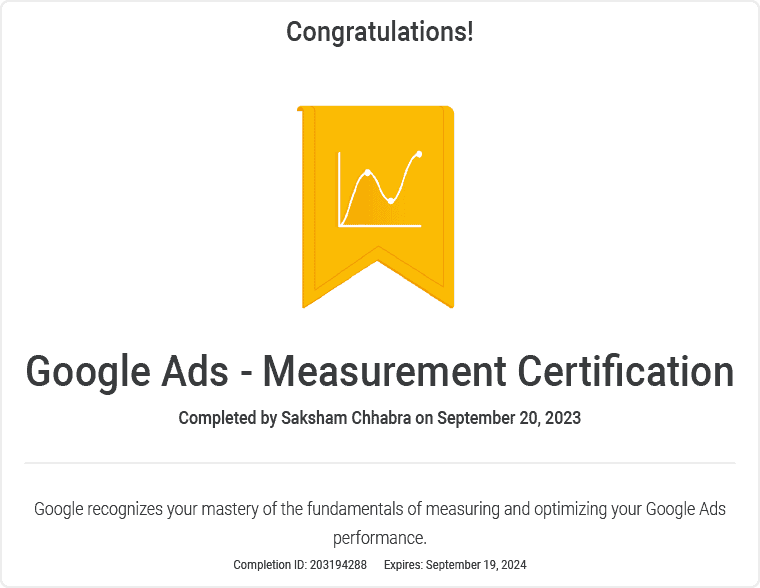
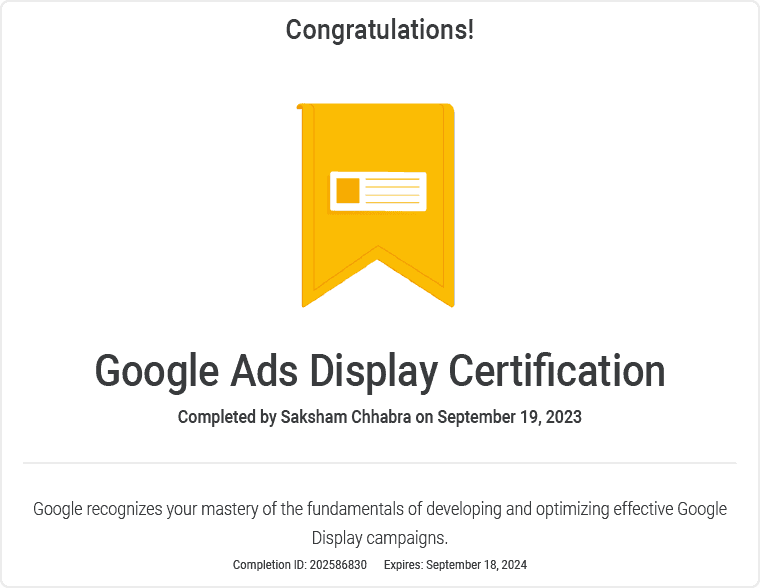
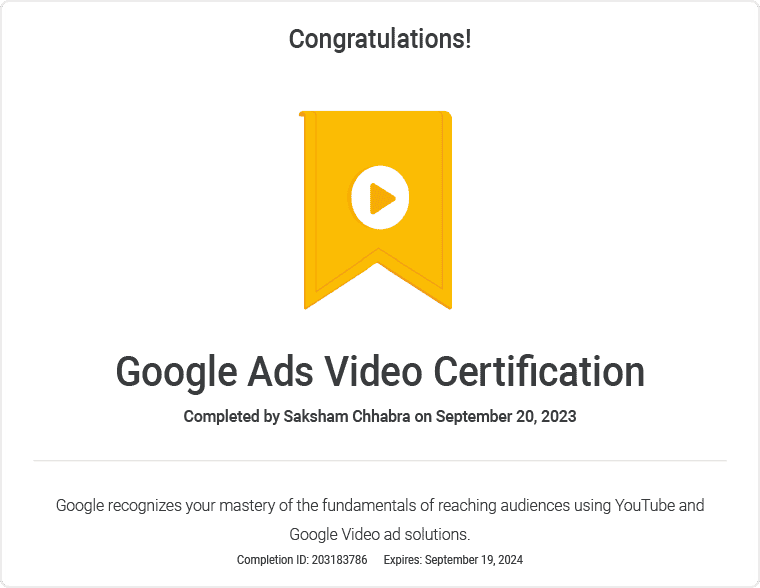
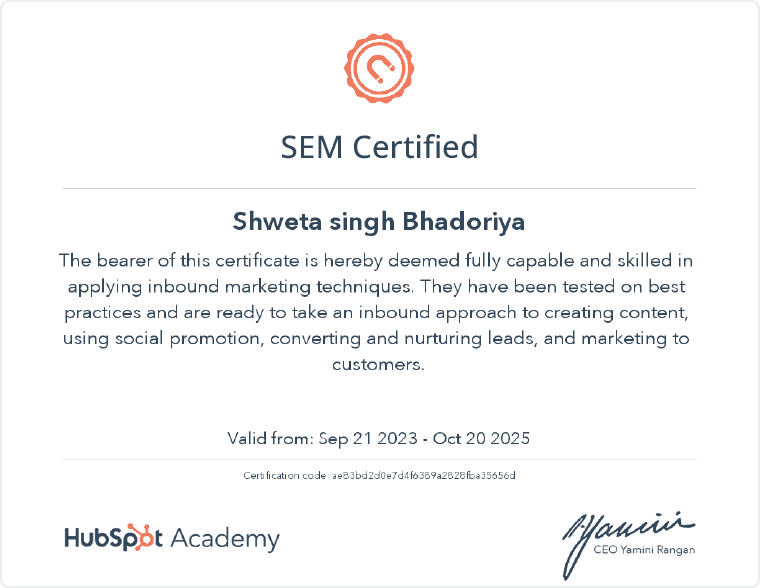
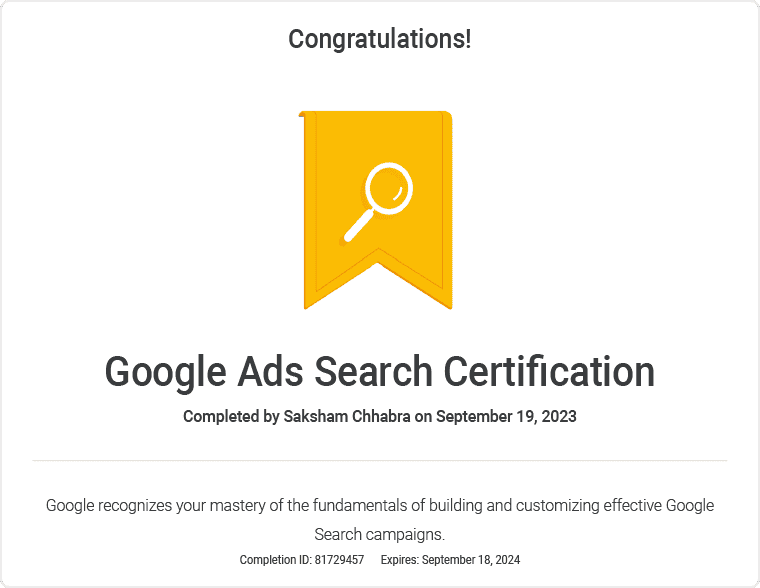
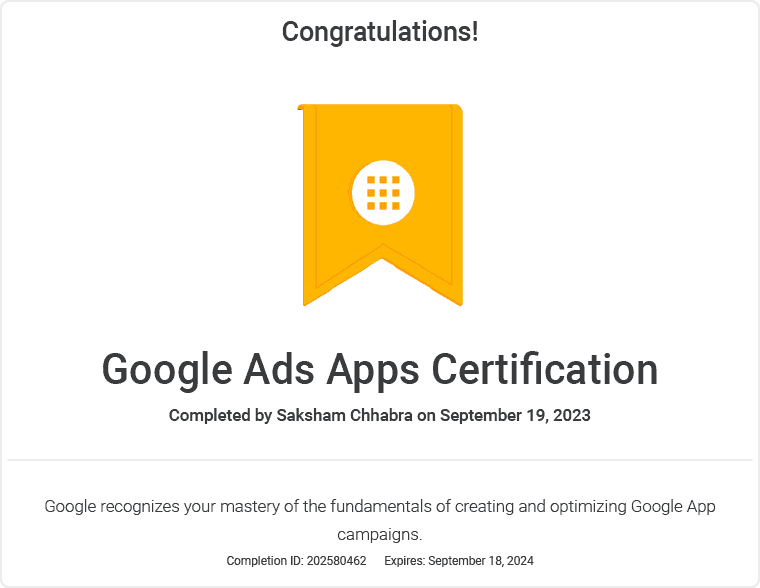
Google Ads Measurement Certificate Google Ads Display Certification Google Ads Video Certification Hubspot Search Engine Marketing Certification Google Ads Search Certification Google Ads Apps Certification vskill Certificate Search Engine Marketing Certificate

Search Engine Marketing - Google Ads Course Assignments

Six graded assignments across twelve hours, each applied to a live Google Ads account in the same week you learn the module. Every one is reviewed by your trainer and returned with written feedback — not auto-marked, and not a quiz.

Nothing here is a simulation. You build the account, write the ads, launch the campaigns and read what actually happened. Three of the six require a live ad budget, paid directly to Google rather than to Digital Vidya — because a campaign that has never spent money teaches you nothing about what happens when it does. If you don’t have a business of your own to advertise, you’re assigned a brand to work on.

Assignment 1 — Keyword Plan and Account Build (Week 1 · 2 hours)

Research a keyword set for a real business in Keyword Planner, classify it by commercial intent, and build the campaign and ad group structure around it. Set your match types deliberately and build a negative keyword list before you spend anything, not after.

You submit: a keyword plan with intent classification and volume data, plus a built account structure with negatives already in place. Tools: Google Keyword Planner, Google Ads Editor

Assignment 2 — Live Search Campaign with AI Max (Week 1 · 2 hours)

Write Responsive Search Ads, add the asset types that matter, configure brand and location controls, and launch. You will run this as an AI Max campaign and explain what you handed to Google’s automation and what you kept.

You submit: a live Search campaign with screenshots of your settings and a short written rationale for each control you set or left off. Tools: Google Ads

Assignment 3 — Ad Copy Test with Gemini (Week 2 · 2 hours)

Use Gemini to draft ad copy variants at scale, then decide which are worth running. Set up a structured test, let it gather data, and interpret the result — including deciding when you don’t yet have enough data to call it.

You submit: your variant matrix with the prompts used, plus performance data and your read of which variant won and why. Tools: Google Ads, Gemini

Assignment 4 — YouTube or Demand Gen Campaign (Week 2 · 2 hours)

Build video and image assets in Canva, define a custom audience segment, and launch a campaign on YouTube or Demand Gen — the campaign type that replaced Discovery and is absorbing standalone Display.

You submit: the creative assets you built and a live campaign with its audience configuration and exclusions documented. Tools: Google Ads, Canva

Assignment 5 — Performance Max Build and Signal Audit (Week 3 · 2 hours)

Structure Asset Groups for a Performance Max campaign, supply audience signals, and set brand exclusions and account-level negatives. Then audit your own setup: what did you actually give Google to work with, and where is it guessing?

You submit: a PMax campaign with your Asset Group logic explained, and a written audit of your audience signals and exclusions. Tools: Google Ads, Merchant Center where applicable

Assignment 6 — Conversion Tracking and Search-Terms Audit (Week 4 · 2 hours)

Install the Google tag, define conversion actions with values, and switch on Enhanced Conversions. Then pull the search terms report from your own campaigns, find the spend that shouldn’t have happened, and turn it into a negative keyword list. Finish by building the report in GA4.

You submit: a working conversion setup, a search-terms audit naming the wasted spend you found, and a GA4 report a client could read. Tools: Google Ads, Google Tag Manager, GA4

Google Ads Capstone Project

The six assignments teach you one thing at a time. The capstone is where you run all of it as one account, for one business, and then answer for the result.

You pick a real business in week one — your own, your employer’s, or one assigned to you — and it stays yours for the whole four weeks. Every assignment you complete feeds this account. By week four you are not looking at exercises; you are looking at a month of your own decisions and what they cost.

The brief

1. Choose the business and set the objective. Leads, sales or traffic — and define what a conversion is actually worth. Everything downstream is judged against this number, so getting it wrong here is part of the lesson.

2. Build the account. Campaign and ad group structure, keyword plan with match types set deliberately, negative keyword lists in place before spend starts.

3. Run the campaigns. A Search campaign using AI Max, plus at least one of YouTube, Demand Gen or Performance Max — with the creative assets you built yourself.

4. Measure it properly. Conversion actions with values, Enhanced Conversions switched on, and GA4 reporting the paid traffic correctly. If the tracking is wrong, nothing after this is worth anything.

5. Audit your own account. Run the 30-point audit framework across everything you built. Find the wasted spend in your own search terms report. Work out your ROAS and say honestly whether it is good for this industry.

6. Present it. Build the report and defend the decisions — including the ones that did not work.

What you deliver

  • A live Google Ads account with campaigns across at least two campaign types
  • Working conversion tracking and a GA4 reporting view
  • A completed 30-point account audit with issues ranked by impact
  • A client-style performance report with your ROAS analysis and what you would do next with a bigger budget

Search Engine Marketing Tools in Our Google Ads Course

Search Engine Marketing (SEM) tools are essential instruments in the digital marketer’s toolkit, designed to optimize online visibility and drive targeted traffic to websites. These tools encompass a wide array of functionalities, catering to different aspects of SEM campaigns. Keyword research tools, such as Google Keyword Planner, Ahrefs and SEMrush, assist marketers in identifying relevant search terms, assessing their competitiveness, and strategizing content creation. Google Ads facilitate the creation, monitoring, and optimization of paid advertising campaigns, allowing marketers to reach their target audience effectively.

Search Engine Marketing - Google Ads Trainers

Avik Nandy
Avik Nandy
AVP Business Operations - Dentsu Merkle Sokrati
Merkle Sokrati
9+ years of Professional Experience as a Performance Marketer
Gurpreet Singh
Gurpreet Singh
Digital Marketing Strategist & Trainer
Webtwix
8+ Years of Experience in Digital Marketing
Anchal Sharma
Anchal Sharma
Digital Marketing Manager
Skillstek
5+ years in Digital Marketing
Tanmoy Das
Tanmoy Das
Digital Marketing Strategist & Trainer
Digital Seekho
10+ Years of Experience in Digital Marketing

Why Learn Google Ads in 2026?

First, the honest answer to the question you are probably asking. Google's certifications are free. You can sit the Search, Display, Video, Shopping and Apps assessments on Skillshop at no cost, and you should. This course prepares you for them. But look at what that certification measures. Each assessment is 75 minutes of multiple choice, 80% to pass, retakeable the next day, and it expires after a year. Nothing in it requires you to have spent a single rupee of real money. You can hold a Google Ads certification and have never built an account, never written an ad that ran, never watched a budget disappear into search terms you did not choose. That gap is why this course exists. In the last quarter of 2025 alone, Google took $63.1 billion in search advertising revenue and $11.4 billion on YouTube. Every rupee of that is someone's budget, and a large share of it is spent badly, by people who passed the free test and then learned the expensive part on their employer's money. Employers are not short of people who know what a match type is. They are short of people who can be handed a monthly budget and trusted with it: who set conversion values before launching, read the search terms report every week, and can explain a bad month instead of hiding it. That is what live and instructor-led buys you. You run real campaigns, and someone who does this for a living tells you what you got wrong in the week you got it wrong. Four weeks. You finish with a live account, campaigns across Search, video and Performance Max, working conversion tracking and an audit of your own spend. The certification is the easy part. The account is what gets you hired.

Best Industry Trainers

Get the chance to learn directly from 10 + Digital Marketing experts with experience of up to 18 + years.

Interactive & Practical

140+ hours of hands-on assignments plus 60 hours of brand case studies with AI Tools

Attend from Anywhere & Save Time

Learn from anywhere with just a laptop & save up-to 120+ hrs of precious time.

Updated Course Recordings

Missed a session live? No issue. Catch up your classes via registered class sessions which you can always access through Learning Portal.

Individual Attention & Collaborative Learning

Intensive classes, brainstorming & a vibrant Q&A community create a perfect environment for collaborative learning.

Master AI Skills

Learn AI skills Including Generative AI, Answer Engine Optimization, AI Marketing Automation with latest AI Tools

Register for Upcoming Batches

Preferred Live Session Days
Open Batch
  • Start Date: Oct 19, 2026
  • Duration: 4 Weeks
  • Delivery: Instructor led Live Online Training
  • Seats Available: 12
₹ 25,000
EMI and Finance Support Available

Certified Google Ads Course FAQs

Google's certification is free. Why should I pay for this course?

You should take the free certification — we prepare you for it and we’ve written a free guide to passing it. But look at what it measures. Each Skillshop assessment is 75 minutes of multiple choice, 80% to pass, retakeable the next day, and it expires after a year. Nothing in it requires you to have spent a single rupee of real money. You can hold a Google Ads certification and have never built an account, never written an ad that ran, and never watched a budget disappear into search terms you didn’t choose. This course is the other half: you build the account, launch the campaigns, spend the budget and answer for the result, with a practitioner reviewing your work each week.

Do I need my own ad budget, and how much?

Yes, for part of it. Three of the six assignments require a live advertising budget, paid directly to Google rather than to Digital Vidya, and you set the daily cap yourself. That’s deliberate: a campaign that has never spent money teaches you nothing about what happens when it does, and the difference between a learner who has watched their own budget leak and one who hasn’t is obvious to any interviewer. The other three assignments need no spend.

Do you cover Performance Max and AI Max?

Both, as full modules rather than mentions. Performance Max gets its own module covering Asset Group structure, audience signals, brand exclusions and how to read performance when the channel breakdown is limited. AI Max for Search is covered in week one — Google began auto-upgrading eligible Search campaigns to it in September 2026 and is retiring Dynamic Search Ads from February 2027, so a course teaching the old setup would already be out of date. We also cover Demand Gen, which replaced Discovery campaigns and is absorbing standalone Display.

How do I get Google Ads certified?

The course prepares you for the Google Skillshop assessments, and we provide mock exams for the Search, Display, Video and Shopping certifications. Each real assessment is 75 minutes, needs 80% to pass, and stays valid for one year.

What is a good ROAS for Google Ads?

It varies by industry, but 4:1 is the usual benchmark. What matters more is knowing how to move it — we teach you to work from the search terms report and negative keyword lists to cut the spend that was never going to convert, which is almost always the fastest available improvement.

I run a business. Will this help me manage my own ads, or brief an agency better?

Both, and the second is the one people underestimate. Most owners paying an agency can’t evaluate the report they receive. After four weeks you’ll know what a reasonable cost per conversion looks like for your category, whether your conversion tracking is actually recording the right thing, and which questions to ask when the numbers move. Several participants run the course on their own business and finish with the account already improved.

What does the course cover?

Ten modules across four weeks: how the auction works, account structure and match types, Search campaigns and AI Max, ad creative with Gemini, Demand Gen, YouTube, Shopping and Merchant Center, Performance Max, Smart Bidding, and privacy-first measurement in GA4. Full module list is in the syllabus section above.

How long is the course, and how many hours a week?

Four weeks. Live sessions run Monday to Friday for two hours, in either an 11 AM–1 PM or 8–10 PM IST batch, plus six graded assignments totalling twelve hours and a capstone project.

Is this for beginners or experienced marketers?

Both, in sequence. Week one assumes no prior knowledge and starts from how the ad auction works. From week two it moves into Performance Max, Smart Bidding and conversion measurement, which is territory most working marketers haven’t covered properly.

What certifications do I receive?

The Digital Vidya Certified Search Engine Marketing certificate, included in the fee. The course also prepares you for the Google Ads Skillshop assessments, HubSpot and Vskills certifications. The Google and HubSpot exams are free to sit on the providers’ own platforms.

What jobs can I do after this, and do you help with placement?

PPC Executive, Paid Search Analyst, Performance Marketing Executive and SEM Specialist are the usual entry points, moving into Performance Marketing Manager or agency account management. Digital Vidya provides placement assistance — resume and LinkedIn profiling, mock interviews, and introductions to hiring partners — not a placement guarantee, and the distinction matters. What actually gets you hired is being able to open your own account in an interview and explain your decisions, which is what the capstone is for.

Discuss With A Career Advisor

Not Sure, What to learn and how it will help you?

Call Us Live Chat Free MasterClass
Scroll to Top