

Do you know how the effectiveness of content marketing is measured?
It is through lead generation. Most marketers have concluded that it is the case studies that bring in the most leads, and are thus the most effective tool or tactic to use.
When B2B buyers conduct an online research for a product or service, they look for reviews, testimonials, and most of all, case studies. Case study, therefore, becomes the most effective digital asset when it comes to B2B sales.
Case studies are thus a very important component of your content marketing toolkit.
If you look at some of the top content marketing case studies, you know what you would find in most of them? That the company promoting its brand has created online-content to educate its audience, including its target customers.
In most cases, the attempt was to create thought leadership. And it was achieved by delivering education and information, with the help of different content-marketing assets and resources.
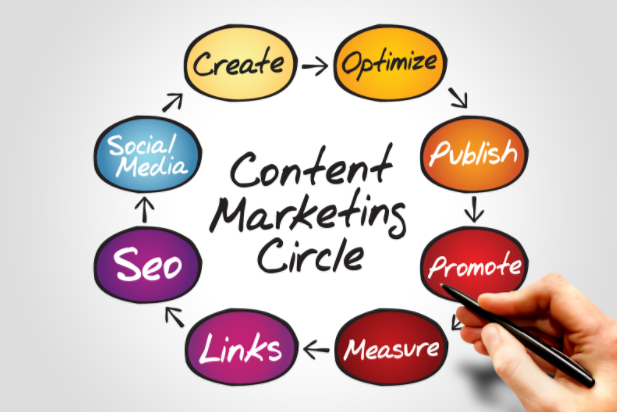
The objective here is to educate the user to understand her need and also the required solutions. In other words, use appropriate content to connect with target customers and build long-term relationships.
Let’s take a look at some case studies of 5 top brands and see how they used content marketing to generate leads and grow their business.
5 Successful Content Marketing Case Studies
1.) Lenovo
Lenovo is one of the largest manufacturer of computer hardware, namely desktop computers, laptops, and related technology products.
Lenovo’s marketing team formulated a content marketing strategy to first create awareness and then build trust among their target audience, which mainly comprises IT professionals. The aim was to help them make informed buying decisions and to keep Lenovo at top-of-mind recall while making those decisions.
Campaign Objective
Create content to educate Lenovo’s target audience and distribute it across multiple channels.
Method and Execution
To execute its content marketing strategy, Lenovo developed a digital content hub called “Tech Revolution” to deliver technical news and technology information to IT decision makers across Asia Pacific region.
They were able to successfully engage with their target audience through this content marketing hub. The leads generated via Tech Revolution, were routed to their website, based on which sales executives were able to readily connect with consumers.
Results
The content marketing strategy of Lenovo was hugely successful in establishing the company as a thought leader. The digital content hub had more than 250 articles with 34 million impressions, 308 link clicks, and was visited by 1,70,000 new web users.
In terms of financials, $300 million in sales was attributable to this initiative alone.
2. Sales Force
CRM (Customer Relationship Management) is among the most competitive domains in the IT industry. Salesforce enjoys a premier position in this segment, being the world’s largest vendor of CRM applications.
While Salesforce was successful in most global locations, it had some issues maintaining steady traffic and leads in its UK business.
Salesforce decided to change their content marketing strategy to achieve business growth in search and paid traffic in UK.
Campaign Objective
To deploy content marketing to entertain and engage target audience in UK to achieve business growth in the region
Method and Execution
Salesforce created the following digital assets:
- Video on sales and marketing which was highly entertaining and fun.
- World’s first stop-motion slide share.
- A Prezi presentation to showcase a customer success story.
Results
Salesforce team in UK achieved some dramatic results as a result of this content marketing campaign.
They enjoyed 80% increase in web traffic, over 10000 downloads of their customized ebook, approximately 6500 email-newsletter signups and a staggering 2500% rise in traffic from social media sites.
3.) SAP
SAP is a behemoth, arguably the largest global vendor of ERP software, which serves almost all industries and diverse organizations all over the world.
SAP wanted to reach out to all of its customers in 19 segments, with an appropriate content marketing strategy.
Campaign Objective
Develop consistent message for all 19 customer segments on a popular topic. Demonstrate and highlight SAP’s software solutions with examples, while educating the target audience about different facets of SAP’s world famous ERP system.
Method and Execution
SAP picked up several topics of interest for each individual customer segment. They also decided to educate the audience on digital technology.
After creating suitable content, SAP distributed the content using the following channels:
- Emails
- Tweets
- Radio ads
- Virtual events
- Post On SAP community network
- LinkedIn status updates
- In person events
- Account based marketing
- Individual account meetings
Results
The content strategy adopted by SAP resulted in very favorable business opportunities. For instance, value of marketing generated (MGS* – Marketing Generated Sales) opportunities was estimated at almost $4 million.
*MGS are new opportunities created from marketing leads, which have been accepted by sales and converted into customer orders.
MTP (Marketing Touched Pipeline) for SAP was pegged to be over $50 million due to this content marketing initiative.
4.) Lead Pages
Lead Pages is a technology company that designs mobile friendly landing-page templates and offers testing services in digital marketing domain. This helps businesses to significantly enhance their reach.
Being a technology company in the content marketing business, the CEO of Lead Pages, Clay Collins knew that he would have to do something innovative to hold his own against digital marketing giants such as Hubspot and InfusionSoft.
Lead Pages did not possess the kind of money for customer acquisition that its competitors were spending. So, for his team Clay created a hypothesis – “a content team of 4 people can outperform a sales team of 80 people at conventional companies”.
Campaign Objective
The basic idea was to adopt inbound marketing and beat other companies, who had been working with the conventional outbound marketing. This was to be achieved by developing a number of content marketing assets for their target audience.
Method and Execution
Lead Pages created the following content marketing assets for this content marketing campaign:
- First set of marketing resources which included seven marketing courses, 2 e-books, 10 case studies, and 8 info-graphics, all offered free-of-cost.
- Popular marketing blog which mainly covered lead generation, a/b testing, and a number of related topics.
- Conversion Cast: This was a marketing podcast run by the world-famous podcaster Tim Paige.
- Weekly webinars covering different topics on digital marketing.

Lead pages’ content marketing resources
Results
The strategy of Lead Pages as also the hypothesis of Clay Collins proved to be highly accurate. All their marketing assets were very well received by their target audience.
Their acquisition cost was extremely low as they acquired 35,000 customers in under 3 years. Their business growth was phenomenal and as a bootstrap startup, Lead Pages generated revenue in excess of $16 million in 2015.
The following year, it was declared as the #148 fastest growing company in the US.
5.) Scripted
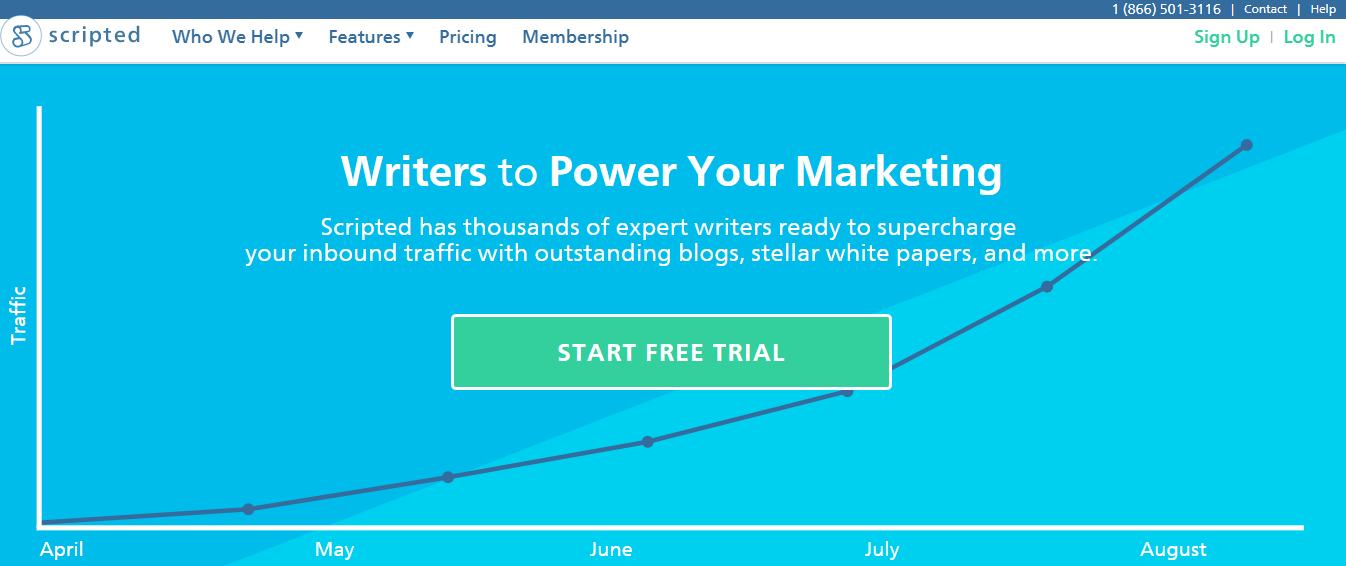
Scripted operates a marketplace of writers, who could help businesses with content creation. Scripted is primarily an aggregator for freelance writers who have the skills to write on different subjects and industry sectors.
These writers have specified rates for content creation, which any individual or a business can make use of. Main competitors of Scripted are Upwork and Fiverr.
Scripted wanted to offer differentiated services. They contended that scripted was not just a marketplace but offered the best subject-specific writers.
Campaign Objective
The main objective of their content marketing strategy was to convince the buyers that scripted offered optimum solutions by helping to select the best writer for specific requirement of their customers.
Method and Execution
Scripted developed a content marketing strategy by looking at different stages of their customers’ problem-solving process.
Scripted created following steps in a customer’s journey to solve its problem:
- Top of the funnel: In this initial stage, Scripted created blogs and podcast to explain the common problems faced by those looking for content writers. The blog content and podcasts were fine-tuned upon receiving feedback.
- Middle of the funnel: In this stage, the visitors had specific requirement for content creation and they needed to be guided. Visitors were now asked to sign up for email, white papers and for participating in webinars. The idea was to guide users on the specific solution they needed and how they could go about it.
- Bottom of the funnel: At this final stage, scripted used case studies to show how different content requirement from different type of businesses were fulfilled and nearly perfect solutions were provided by Scripted. Apart from case studies, customers were also familiarized with offers by Scripted and how each of its services fulfilled specific needs.
Results
The strategy of guiding potential customers in 3 different stages and also the initiative to convince them about usefulness of different solutions on offer, proved to be highly successful.
Results were way more than encouraging as seen below:
- In the first stage of blog post and podcast, 46% of visitors went to the next stage which was an improvement of 3 times over other online assets.
- The bounce rate from Scripted microsite was 3 times lower than other sources.
- The visitors who came to Scripted website through one of their content hubs, browsed at least 4 pages per visit. This was the second highest time spent on website among all traffic sources.
What’s Your Content Marketing Case Study?
All of the above case studies prove one thing beyond doubt. That an innovative approach to content marketing works for all kinds of products and services, specially if deployed as an inbound marketing strategy.
Even for the traditional biggies like Lenovo and SAP, who have very little of their business transacted online, content marketing has been very effective. Thus, when it comes to lead generation, content marketing is in a league of its own.
To elevate your content marketing strategy, have a look at these amazing content marketing examples and Digital Marketing Case Studies to understand the power of Digital Marketing.
Does your brand have created its own Content Marketing Case Study to earn a place in the hall of fame?
Are you working on making a successful Content Marketing Case Study for your brand?
Let us know and we would love to feature it in our list here.
Image Courtesy : egainz.com, Lead Pages, Scripted