
An SEO executive is responsible for planning, implementing, and monitoring SEO campaigns for their organization. They work closely with other marketing team members to ensure that SEO strategies are aligned with overall marketing objectives.
The SEO executive / digital marketing executive will also be required to keep up to date with the latest industry trends and developments to make recommendations on improving the SEO of their organization’s website.
They should also have a strong understanding of analytics and be able to use data to drive SEO decision-making.
Who is an SEO Executive & What is he supposed to do?
SEO executive full form is Search Engine Optimization executive. According to Moz, SEO is the practice of increasing the quantity and quality of traffic to your website through organic results.
The job profile of SEO executives pronounces his work to be including all the tasks that must be undertaken by him to keep the SEO activities of the company proceeding in order.
According to Search Engine Journal, the overall job market has been good, but SEO has been growing over 5X faster.
This proves that SEO offers promising digital marketing career opportunities. Let us now understand who is an SEO executive and what is he supposed to do.
He/she is a human resource in the SEO hierarchy that stands above the trainee or intern. What exactly does he do?
- Conducting on-page and off-page SEO
- Assigning the tasks to the SEO trainees
- Finding keywords with the help of SEO tools
- Completing tasks delegated by the senior personnel
- Closely coordinated with the content department and social media marketing department
- Watching over the activities of the competitors to stand at pace with the competitors.
- An analysis of both the internal and external activities is a part of the basic tasks that must be performed by an SEO executive.
The above-mentioned pointers are some of the many tasks enlisted to be done by the mentioned human resource. However, it is an obvious fact that work profile may vary from one company to the other.
Let us take a look at how companies define SEO Executive job descriptions.
The Job Description of an SEO Executive
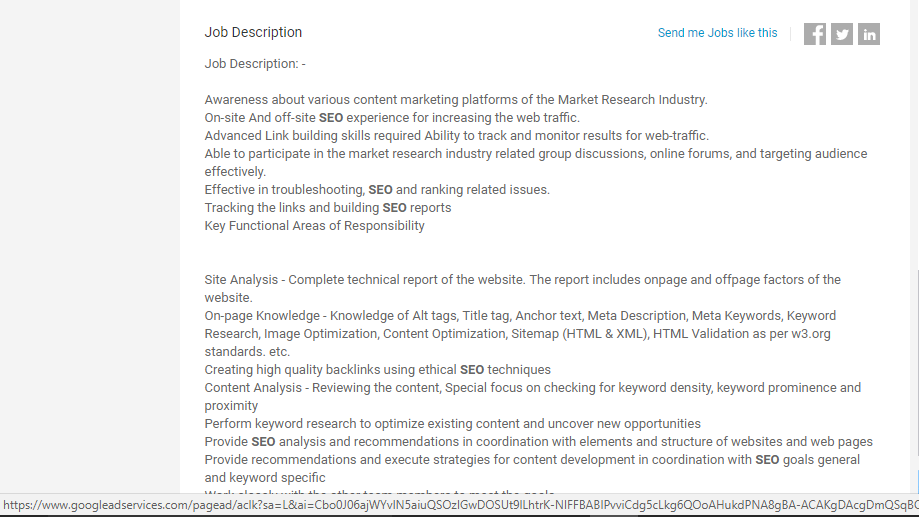
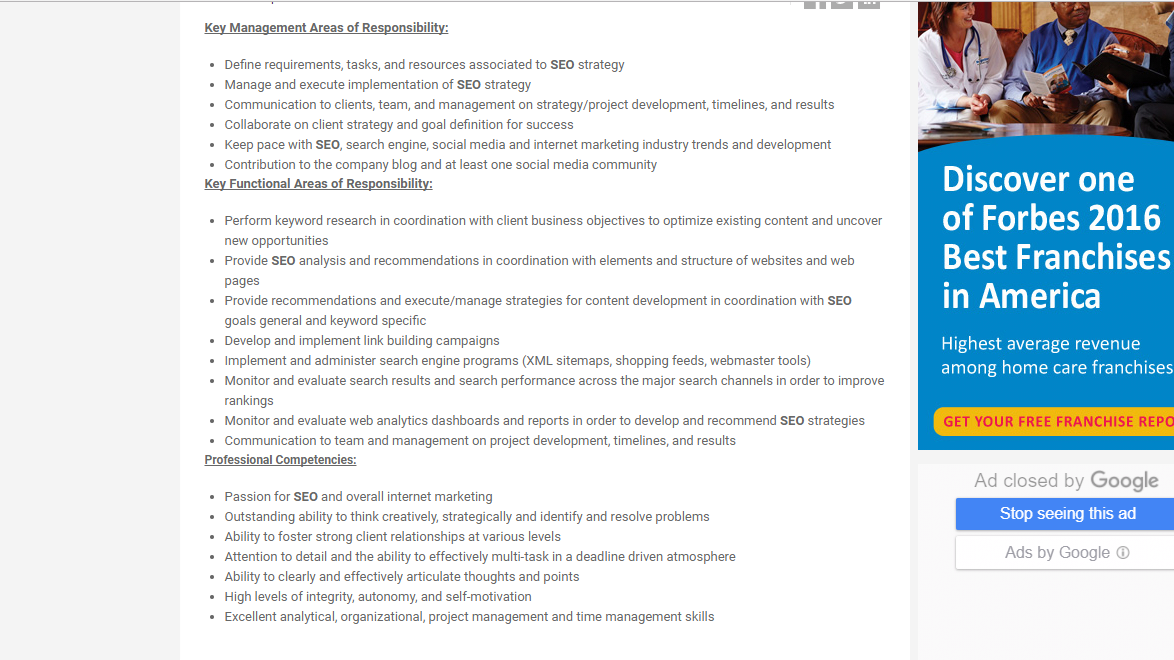
SEO Executive Job Description : The samples of the job description of the profile of an SEO specialist job clearly show that there is a relative difference in the tasks expected out of an SEO executive from one company to the other.
There may be many tasks included in the job description and each company may present the job description with its own varied version but the primary task remains to be contributing to the SEO of the company’s website.
They may be assigned 100 tasks and all of them would be contributing to the SEO company’s website, directly or indirectly.
Core Duties & Responsibilities: What Does an SEO Executive Actually Do?
In 2026, an SEO Executive’s role has evolved far beyond just “finding keywords.” Today, you are the bridge between the technical health of a website, the quality of its content, and the user experience.
Here are the 4 main pillars of responsibility you will handle daily:
1. Technical SEO Audits & Health Maintenance
Before content can rank, search engines must be able to read it. You are responsible for the site’s “hygiene.”
- Crawl Error Resolution: Regularly checking Google Search Console to identify and fix “Not Found” (404) errors, server errors (5xx), and broken links that frustrate users and bots.
- Technical Audits: Using tools like Screaming Frog or Semrush to find duplicate content, missing meta tags, or redirect chains that dilute ranking power.
- XML Sitemaps & Robots.txt: Ensuring the roadmap you give to Google (the sitemap) is clean and that you aren’t accidentally blocking important pages via the robots.txt file.
2. Strategic Content Planning & Gap Analysis
Keyword research is no longer just about volume; it’s about User Intent.
- Intent Mapping: Categorizing keywords by intent (e.g., Informational vs. Transactional). You ensure that blog posts answer questions while product pages drive sales.
- Content Gap Analysis: Analyzing competitor websites to find topics they have covered but you haven’t. You will create content briefs to help your writers fill these gaps.
- On-Page Optimization: Going beyond inserting keywords. You will optimize Header tags (H1, H2, H3), improve internal linking structures to spread authority, and ensure images have descriptive Alt Text.
3. User Experience (UX) & Core Web Vitals Collaboration
Google now prioritizes how a user experiences a page. You will work closely with developers to ensure the site is fast and stable.
- Monitoring Core Web Vitals: You are responsible for tracking LCP (Loading speed), INP (Interactivity), and CLS (Visual Stability). If a page loads too slowly, it is your job to flag it to the dev team.
- Mobile-First Optimization: Verifying that all pages render perfectly on mobile devices, as Google uses the mobile version of your site for indexing.
- Schema Markup: Implementing structured data (Schema) to help search engines understand your content better and win “Rich Snippets” (like Star Ratings or FAQ boxes) in search results.
4. Data Analysis & Performance Reporting
You don’t just do the work; you prove that it works.
- Traffic Analysis: Using Google Analytics 4 (GA4) to track not just how many people visit, but how they behave (Bounce rate, Engagement time).
- ROI Tracking: Connecting SEO efforts to business goals. Did that blog post lead to a newsletter signup? Did that product page optimization increase sales?
- Algorithm Monitoring: Keeping a close eye on Google Algorithm Updates and adjusting strategies if rankings fluctuate.
The SEO Tech Stack: Essential Tools You Must Master
In 2026, an SEO Executive does not guess; they analyze. To do this, you need to be proficient with a specific set of tools. You don’t need to know every tool in the market, but you must master the “Big 4” categories used by top agencies and brands.
1. Crawlers & Technical Auditing (The “X-Ray” Machines)
These tools scan your website like a search engine bot does, highlighting technical breaks before they hurt your rankings.
- Screaming Frog SEO Spider: The industry standard for technical audits. You will use this weekly to find broken links (404s), missing meta tags, and oversized images.
- Lumar (formerly DeepCrawl): Often used in enterprise-level companies to monitor large websites with thousands of pages.
2. Analytics & Performance (The Scorecards)
You cannot improve what you cannot measure. These free tools from Google are your daily dashboards.
- Google Search Console (GSC): Your primary source of truth for organic performance. You will use it to check clicks, impressions, and indexation issues (pages not showing up in Google).
- Google Analytics 4 (GA4): Used to understand user behavior. Once a user clicks on your site, GA4 tells you if they bought a product, signed up for a newsletter, or left immediately (bounce rate).
3. Research & Market Intelligence (The Spyglass)
These tools help you understand your market and spy on competitors.
- Ahrefs & Semrush: The heavy hitters of SEO. You will use these for:
- Keyword Research: Finding high-volume, low-competition terms.
- Backlink Analysis: Seeing who links to your competitors but not you.
- Rank Tracking: Monitoring where your keywords stand on the SERP (Search Engine Results Page).
4. Project Management (The Organizers)
SEO is cross-functional. You will work with writers, developers, and designers. You need a system to track tasks.
- Trello / Asana / Jira: Used to create content calendars and track technical tickets. For example, if you find a slow-loading page, you will create a ticket in Jira for the developer to fix it.
- Slack / Microsoft Teams: For real-time communication with the content team to ensure SEO guidelines are followed in new blogs.
Pro Tip: While paid tools like Ahrefs are powerful, most successful SEO executives start by mastering Excel (or Google Sheets). Being able to filter data and create Pivot Tables is a mandatory skill for analyzing large keyword lists.
Beyond the Job Description: A Day in the Life of an SEO Executive (2026)
Job descriptions often look like boring shopping lists of skills. But what does it actually feel like to work in SEO? It’s rarely about sitting alone in a dark room with a spreadsheet. It’s dynamic, collaborative, and sometimes a little chaotic.
Here is a realistic hour-by-hour breakdown of what your Tuesday might look like:
🕘 9:00 AM: The “Health Check” (Coffee & Console) You don’t start with emails; you start with data. You open Google Search Console to check the “pulse” of the website.
- The Scenario: You notice a sudden dip in traffic for your top-performing blog post.
- The Action: You don’t panic. You check the “Performance” tab and realize the page accidentally got de-indexed during a code update yesterday. You instantly flag this to the dev team. Crisis averted.
🕚 11:00 AM: The Detective Work (Competitor Gap Analysis) Now that the house is safe, it’s time to grow. You open Semrush or Ahrefs to spy on the competition.
- The Scenario: Your biggest competitor just launched a “2026 Buying Guide” that is stealing your customers.
- The Action: You analyze their keywords. You realize they are ranking for “budget-friendly options” while your page only covers “premium options.” You add a note to your content plan to fill this gap immediately.
🕑 2:00 PM: The Bridge Builder (Content Team Meeting) SEO is nothing without content. You sit down with the creative writers.
- The Scenario: The writers want to write a poetic, flowery article about “The Essence of Summer.”
- The Action: You put on your “Data Hat.” You explain that users aren’t searching for “Essence of Summer”; they are searching for “Best Summer Skincare Routine for Dry Skin.” You help them balance their creativity with Search Intent, ensuring the article actually gets read.
🕓 4:00 PM: The Technical Tune-Up (Audits & Fixes) The creative energy is done; now you need focus. You open Screaming Frog to run a mini-audit.
- The Scenario: You find 15 images on the homepage that are over 2MB each, slowing down the site speed (Core Web Vitals).
- The Action: You resize and compress them, or convert them to WebP format. You also fix three broken links (404 errors) that were frustrating users.
🕠 5:30 PM: The Future-Proofing (Learning & Research) SEO changes while you sleep. Before you sign off, you spend 20 minutes reading Search Engine Land or checking Google’s official blog.
- The Scenario: Google just hinted at a new AI-search update affecting review sites.
- The Action: You share a quick summary in the company Slack channel: “Heads up team, we need to update our review schema by next week to stay safe.” You end the day not just as an executive, but as a trusted advisor.
The Reality: Some days are heavier on data, others on writing. But the common thread is problem-solving. You are constantly asking: “How can I get us more visibility than we had yesterday?”
Soft Skills for SEOs: The “Hidden” Requirements
Mastering tools like Ahrefs and Google Analytics is mandatory, but soft skills are what separate a good SEO Executive from a great one. In an industry that changes every day, your mindset is just as important as your toolset.
Here are the 3 non-technical skills you need to survive and thrive:
1. Curiosity (The “Why” Factor)
SEO is essentially a giant puzzle. There is rarely a “textbook” answer for why a ranking dropped or why a competitor is winning.
- Why it matters: You can’t just accept data at face value. You need the itch to dig deeper. Why did organic traffic spike on Tuesday? Why is this specific page loading slowly?
- In Action: Instead of just reporting “Traffic is down 10%,” a curious SEO digs into the data to find the root cause (e.g., “Traffic is down because our top blog post lost the Featured Snippet”).
2. Adaptability (Surviving the Updates)
Google updates its algorithm thousands of times a year. Strategies that worked in 2023 might get you penalized in 2026.
- Why it matters: If you get frustrated by change, SEO is not for you. You need to be comfortable pivoting your entire strategy overnight if Google announces a new Core Update.
- In Action: When Google shifted focus to “Helpful Content,” adaptable SEOs stopped writing for bots and started writing for humans, while rigid SEOs lost rankings.
3. Communication (The “ROI” Interpreter)
This is often the biggest gap in the industry. Your boss or client likely doesn’t know what “Canonical Tags” or “Schema Markup” are—and they don’t care. They care about Revenue and Leads.
- Why it matters: You must be able to translate “Geek Speak” into “Business Speak.” You need to explain why fixing a technical error is worth their money.
- In Action:
- Bad Communication: “I fixed the Hreflang tags on the subdirectory.” (Client is confused).
- Good Communication: “I fixed a technical issue that was preventing our US products from showing up for US customers. This should improve our international sales.” (Client is happy).
The Bottom Line: You can teach someone how to use a tool in a week. But you cannot easily teach curiosity or the ability to stay calm during an algorithm update. Cultivate these traits early.
Competitor Analysis: Reverse Engineering the Market Leaders
In the offline world, Coke monitors Pepsi’s pricing. In the online world, an SEO Executive monitors a competitor’s Keywords, Backlinks, and Content Velocity.
You aren’t just “watching” them; you are reverse-engineering their success to find opportunities they missed.
The Real-World Example: Amazon vs. Flipkart Imagine you are handling SEO for a niche electronics brand. You are up against giants like Amazon and Flipkart. You cannot beat them on “Domain Authority” overnight, but you can outsmart them on “Specific Intent.”
- The Scenario: Both Amazon and Flipkart are fighting for the head keyword “Best 5G Smartphone.”
- Your Job as an SEO Exec: You analyze their pages and realize they are just listing products. They lack in-depth guidance.
- The Opportunity: You advise your team to create a “Buying Guide” or a “Comparison Tool” for 5G phones. While the giants fight for the transaction, you capture the research phase of the user journey.
What You Must Analyze Daily: Instead of just looking at their home page, you will use tools like Semrush or Ahrefs to dig into:
- Keyword Gap Analysis: Which keywords are your competitors ranking for that you aren’t? (e.g., If a competitor ranks for “sustainable running shoes” and you don’t, you are losing that traffic).
- Backlink Profile: Where are they getting their authority from? If a competitor got a feature in a major tech blog, can you pitch a better story to that same blog?
- Content Updates: Did a competitor recently rewrite their “Top 10” list? If they updated their content and their ranking jumped, it’s a signal that Google prefers fresh data for that topic.
- SERP Features: Are they winning the “Featured Snippet” (position zero)? If so, you need to structure your content better (using lists or tables) to steal that spot.
Key Takeaway: You don’t always have to reinvent the wheel. Sometimes, the best SEO strategy is finding the gaps your competitors left behind and filling them with better, faster, and more helpful content.
SEO Executive Salary in India (2026 Data)
One of the most common myths is that SEO is a low-paying entry job. In 2026,that is no longer true—if you have the right skills. While generalist roles have seen steady growth, specialized roles in Technical SEO and Data Analytics have seen salary spikes of up to 30-40%.
Below is the breakdown of what you can expect to earn based on your role, skills, and employer type.
1. Salary by Experience Level
- Fresher (0-1 Year): ₹2.5 LPA – ₹4.5 LPA
- Note: The days of ₹15k/month salaries are fading for qualified candidates. Freshers with certification (like CDMM) and practical portfolio work often start at ₹25k+.
- Mid-Level (2-4 Years): ₹5.0 LPA – ₹9.0 LPA
- Focus: At this stage, you are expected to handle independent audits and content strategies.
- Senior/Manager (5+ Years): ₹12.0 LPA – ₹25.0 LPA+
- Focus: Managing teams, forecasting revenue, and aligning SEO with business goals.
2. The “Skill Premium”: Why Technical SEO Pays More
Not all SEO roles are paid equally. Specialized skills command a significant premium in the job market.
| Specialization | Typical Salary Hike | Why? |
| Generalist SEO | Base Market Rate | Focuses on standard keywords and basic on-page tasks. |
| Technical SEO | +30% Higher | Requires knowledge of JavaScript, Log File Analysis, and Core Web Vitals. Harder to replace. |
| E-commerce SEO | +25% Higher | Directly tied to revenue for giants like Amazon, Flipkart, or D2C brands. |
| SEO + AI Ops | +15-20% Higher | Involves using AI to scale content briefings and automate meta-data creation. |
3. Agency vs. In-House: Where Should You Start?
Your salary often depends on where you work.
- Digital Marketing Agencies:
- Salary Range: ₹2.5 LPA – ₹6.0 LPA (Early Career)
- Pros: Rapid learning curve. You work on 10+ industries in a year.
- Cons: Often lower starting pay compared to product companies.
- Verdict: Best for learning fast in your first 2 years.
- In-House (Product/Tech Companies):
- Salary Range: ₹4.0 LPA – ₹8.0 LPA (Early Career)
- Pros: Higher starting packages, better benefits, and focus on a single website.
- Cons: Harder to get into without prior experience or a strong portfolio.
- Verdict: Best for earning well once you have mastered the basics.
Pro Tip for 2026: Don’t just negotiate your salary based on “years of experience.” Negotiate based on your Technical Stack. If you know how to use Python for SEO automation or can audit a React-based website, you are instantly in the top 10% of earners.
Your Career Path: From Executive to Leader
An SEO career is not a dead-end job; it’s a well-defined ladder that leads to senior leadership roles in marketing. As you move up, your focus shifts from execution (doing the tasks) to strategy (planning the direction) and finally to leadership (managing people and budgets).
Here is the typical growth path for a dedicated SEO professional in 2026:
Stage 1: The Doer
- Role: Junior SEO Executive / SEO Executive
- Experience: 0 – 2 Years
- Focus: Execution & Learning.
- What You Do: You are in the trenches. Your days are filled with keyword research, writing meta tags, fixing broken links, and generating basic reports from Google Analytics. You learn how the tools work.
Stage 2: The Strategist
- Role: Senior SEO Executive / SEO Strategist
- Experience: 2 – 5 Years
- Focus: Analysis & Planning.
- What You Do: You stop just following instructions and start creating them. You conduct deep competitor analysis, plan content calendars based on user intent, and start handling client or stakeholder communication. You move from “fixing an error” to “understanding why the error happened and preventing it.”
Stage 3: The Manager
- Role: SEO Manager / Team Lead
- Experience: 5 – 8 Years
- Focus: People & Process.
- What You Do: Your tool time decreases, and your people time increases. You hire and train junior executives, manage team workflows, and are responsible for the overall performance of the SEO channel. You translate SEO data into business language for upper management.
Stage 4: The Leader
- Role: Head of SEO / Director of Organic Growth
- Experience: 8+ Years
- Focus: Vision & Revenue.
- What You Do: You are no longer just an “SEO guy/gal”; you are a business leader. You set the long-term vision for organic growth, manage substantial budgets for tools and content, and collaborate with other department heads (Product, Sales, Paid Media) to ensure SEO is integrated into the company’s entire strategy. Your success is measured not by rankings, but by revenue contributed.
AI & The Future of SEO: Evolution, Not Extinction
The biggest question in 2026 isn’t “How do I do keyword research?”—it’s “Will AI take my job?”
The honest answer is: AI will not replace SEO Executives. But an SEO Executive using AI will replace one who doesn’t.
In the modern landscape, tools like ChatGPT, Claude, and Gemini are not your enemies; they are your interns. They handle the repetitive grunt work, freeing you to focus on strategy and creativity.
How SEO Executives Use AI in 2026
Gone are the days of manually writing 50 meta descriptions in a spreadsheet. Here is how you will use AI to supercharge your workflow:
1. Automating Technical Grunt Work
- Schema Markup Generation: Instead of coding JSON-LD manually (and risking syntax errors), you can prompt AI: “Generate FAQ Schema code for a page about ‘Digital Marketing Courses’ with these 3 questions…” You simply validate the code and deploy it.
- Regex Creation: Need to filter specific URLs in Google Search Console but don’t know Regular Expressions? AI can write the complex query strings for you in seconds.
2. Content Strategy & Ideation (Not Just Writing)
- Brief Creation: You can feed top-ranking competitor pages into an AI tool and ask: “Analyze these 3 pages and create a content outline that covers all their points plus any missing content gaps.”
- Meta Tag Bulk Creation: “Generate 10 engaging Title Tags for a blog post about ‘SEO Salaries’, keeping them under 60 characters and including the current year.” Your job shifts from writing to choosing the best option.
3. Data Analysis Assistant
- Pattern Spotting: You can upload a CSV export from Google Search Console to a tool like ChatGPT (with Data Analyst capabilities) and ask: “Identify keywords where we rank in positions 4-10 and have a high click-through rate potential.” It does the math; you execute the strategy.
The New Skill: “Prompt Engineering” for SEO
Being an SEO Executive now requires knowing how to talk to these machines.
- Weak Prompt: “Write an article about SEO.” (Result: Generic, robotic content).
- Strong Prompt: “Act as a Senior SEO Strategist. Create a semantic content structure for the keyword ‘SEO Executive Jobs’ targeting an Indian audience. Include LSI keywords related to salary, career growth, and required tools.” (Result: High-value, usable output).
Warning: AI is confident but often wrong. It can “hallucinate” facts or invent keywords that don’t exist. Your role as the human editor and strategist is to verify everything. AI provides the draft; you provide the accuracy and the “human touch.”
The Current Market Status of SEO Executive Jobs Across the Country
The development level of the various cities and towns across India results in different employment levels.
When we talk of the market status for the profile of an SEO executive, we refer to the availability of the jobs in that particular city or town.
(i) SEO Executive Jobs in Kolkata
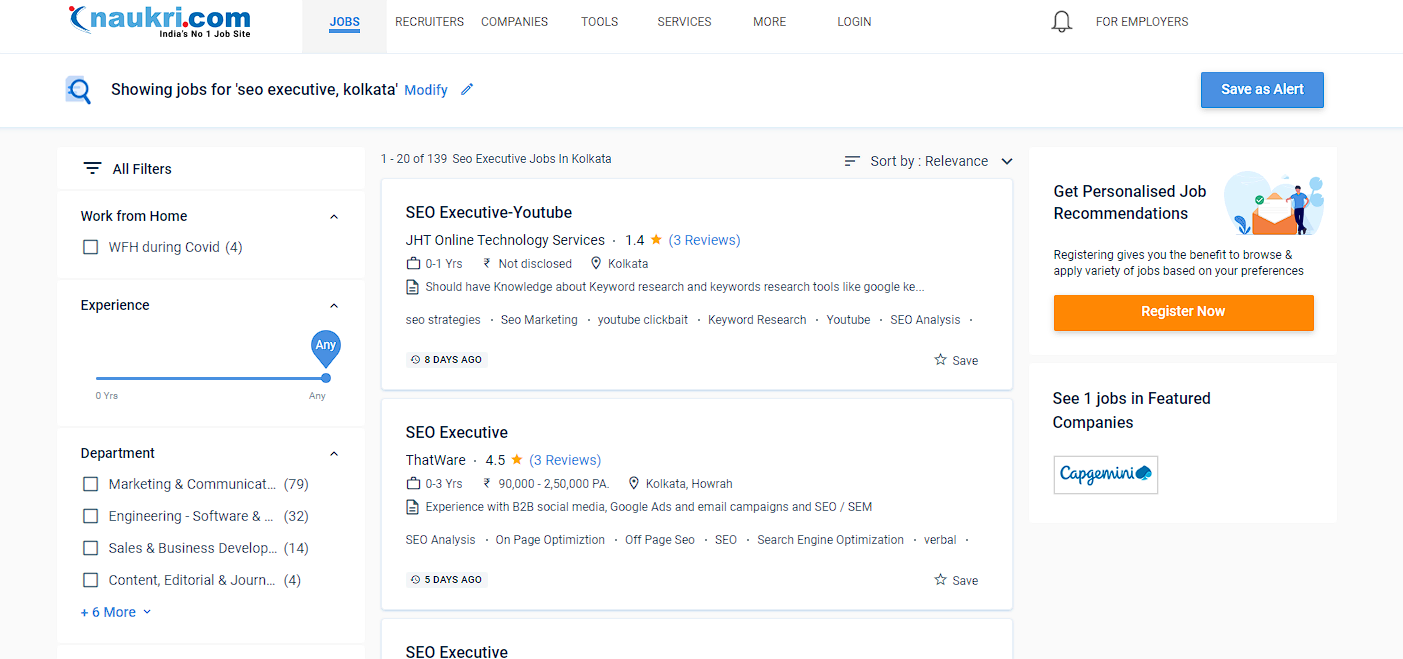
As per the famous job portal, Naukri.com, the number of jobs for the profile is approximately 140.
(ii) SEO Executive Jobs in Pune
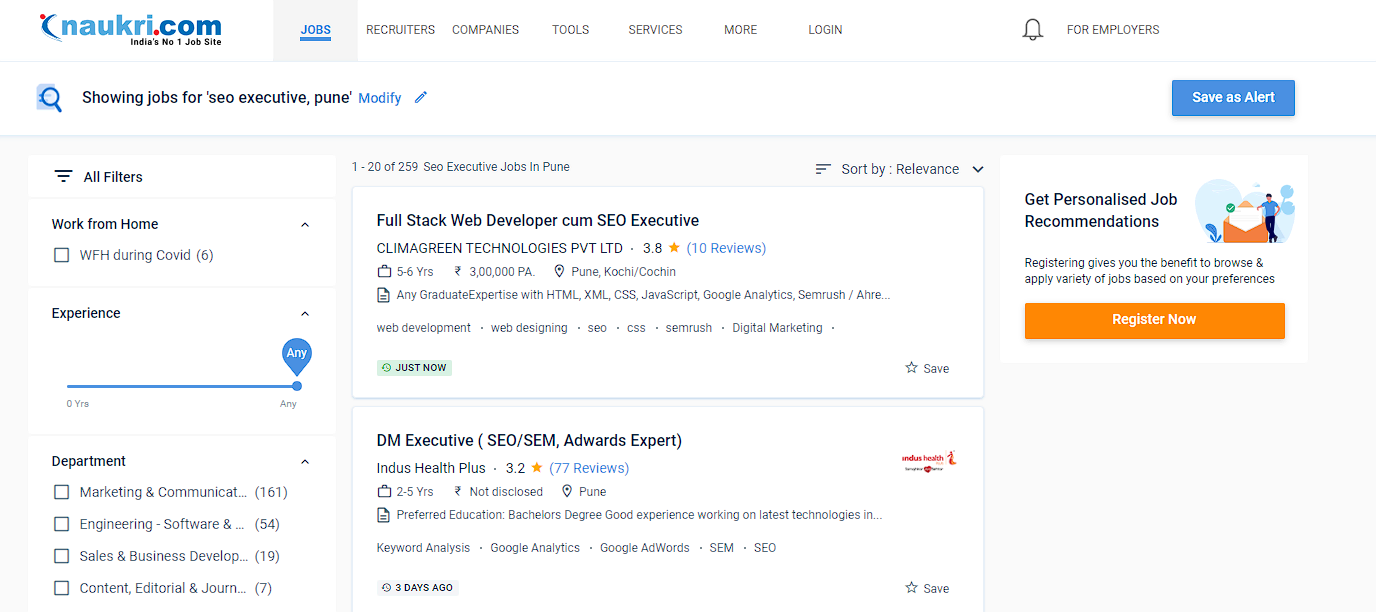
The number of jobs for the same profile in Pune reflects the number 260 on the job portal.
(iii) SEO Executive Jobs in Gurgaon
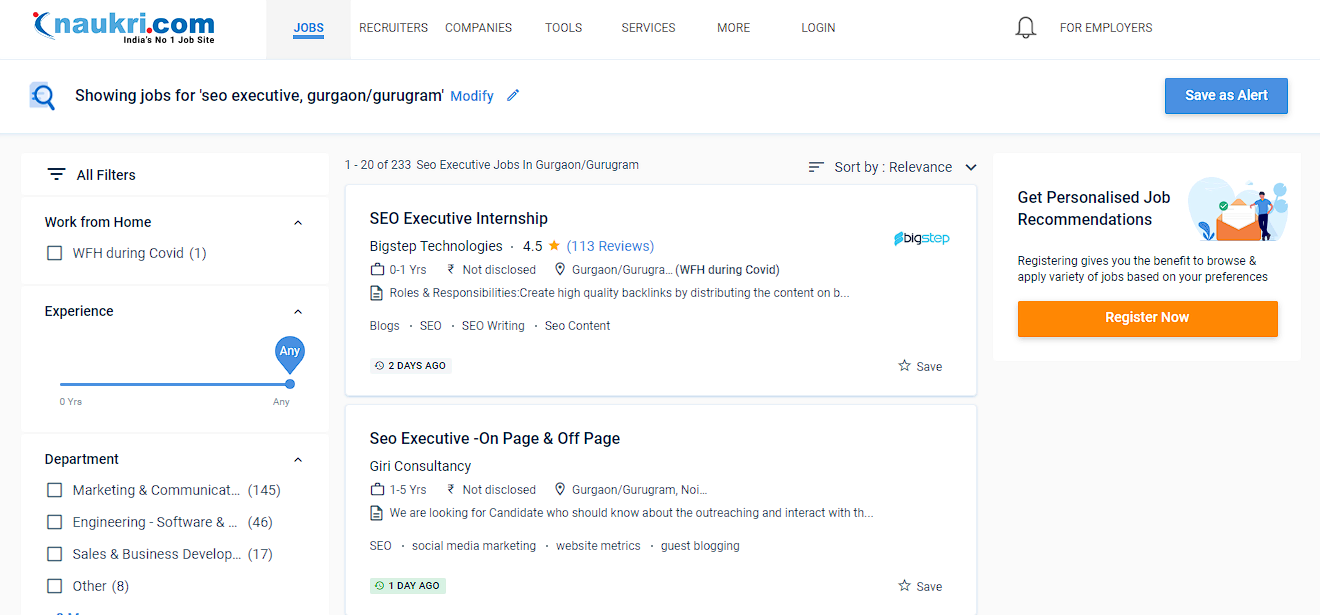
The screenshot shows a total of 234 jobs for the mentioned profile in Gurgaon on today’s date.
(iv) SEO Executive Jobs in Jaipur
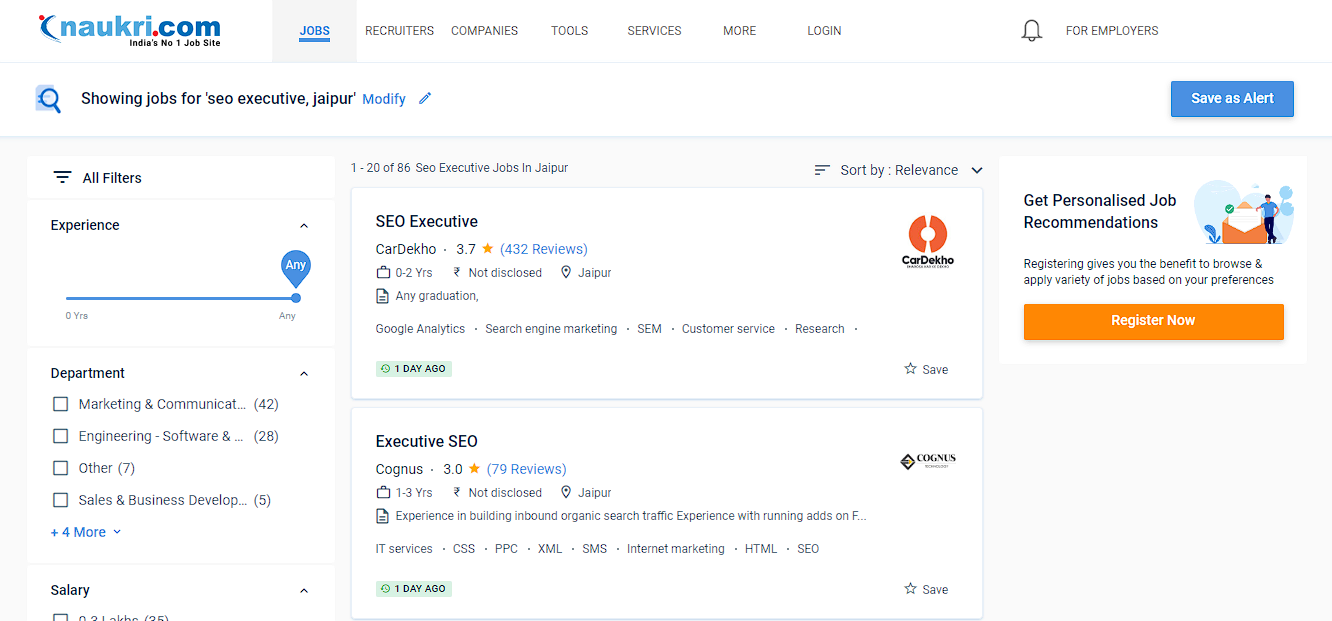
The screenshot shows a total of 84 jobs for the mentioned profile in Jaipur on today’s date.
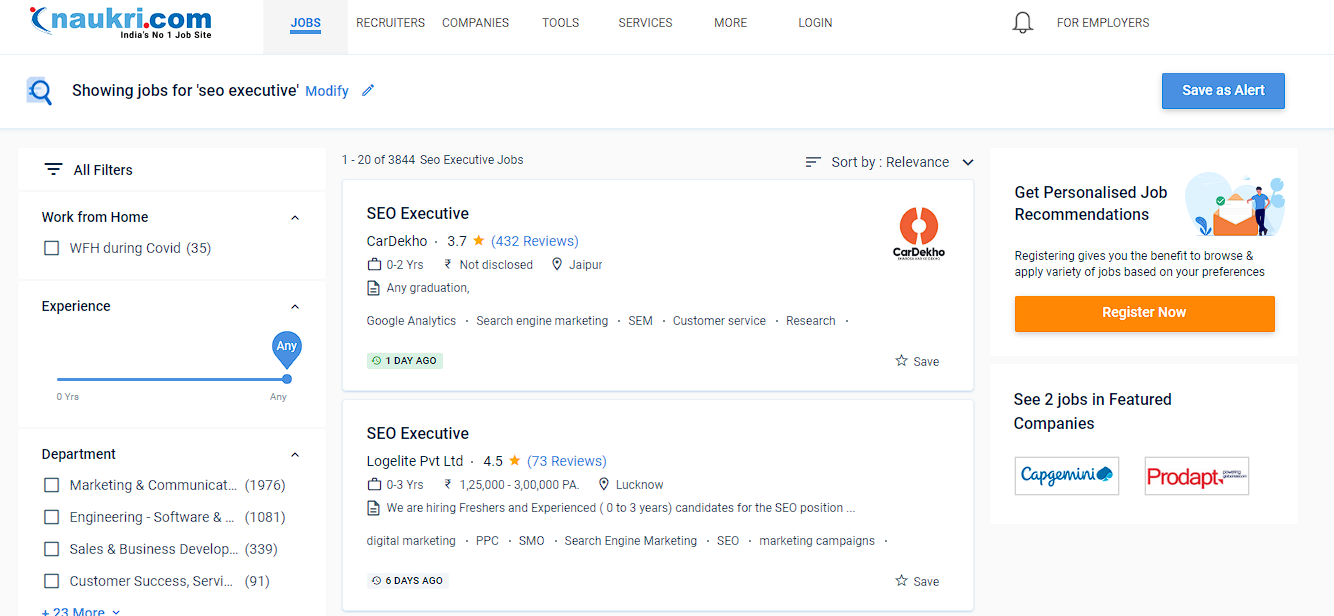
(v) Overall SEO Executive Jobs in India
The SEO Resume Format
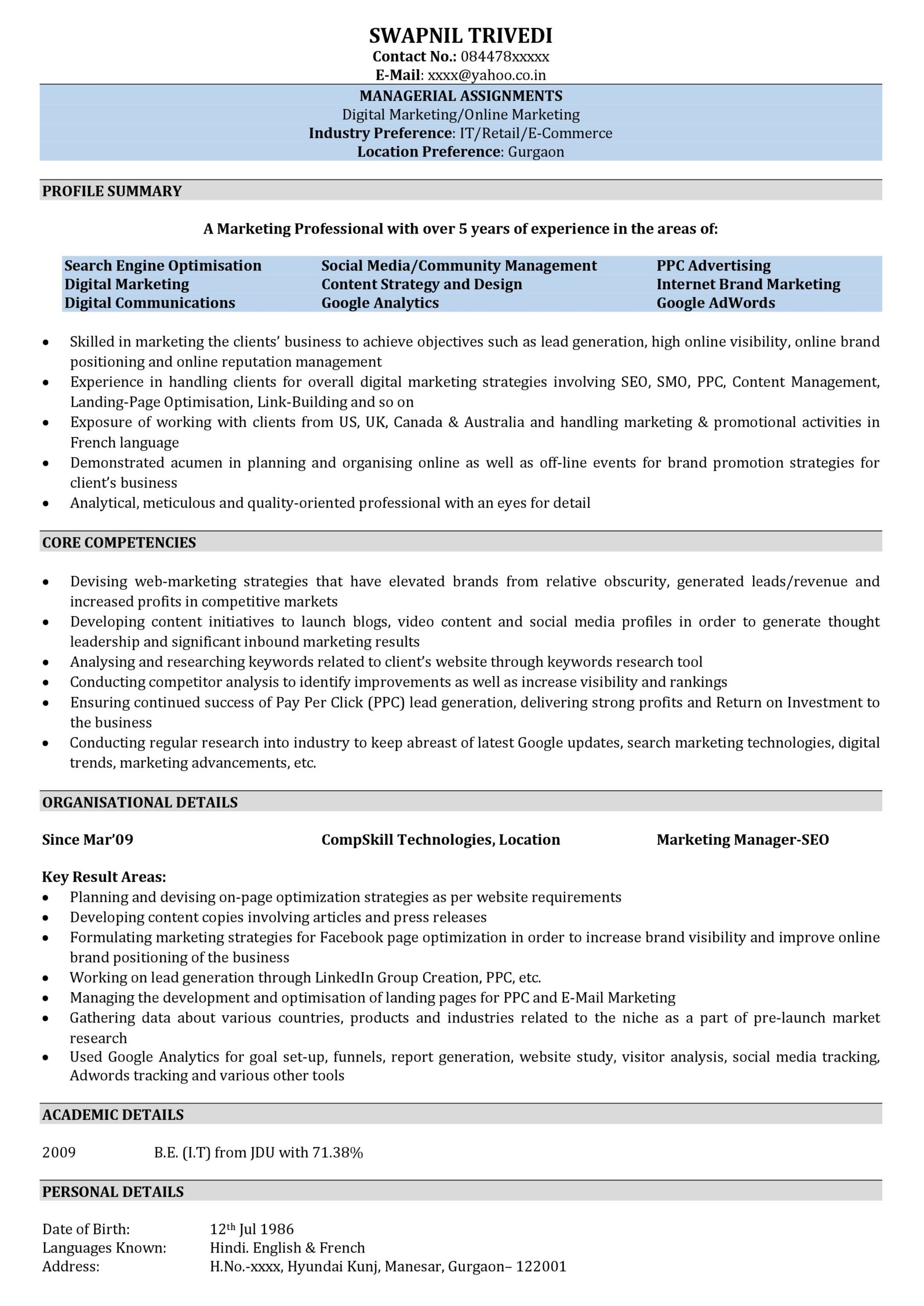
Mere skills do not fetch you a job. The presentation skills have their own fair share of roles to play. A well-presented and information-equipped resume are ideal for attracting the recruiter’s attention and bagging your dream job.
No doubt the SEO skills of an individual have their own importance yet it must not be forgotten that the SEO resume is the first interaction of the candidate with the recruiter before you finally sit for the interview (SEO interview questions and answers).
Let us take a look at the ideal resume format for an SEO Executive:
How to become an SEO Expert?
There is no one specific path to becoming an SEO executive, but most will likely have a background in marketing or web development. It is also important to have strong analytical and research skills, as well as experience with SEO tools and best practices.
Some SEO executives may choose to pursue formal qualifications, such as a bachelor’s degree in marketing or a master’s degree in digital marketing.
However, SEO is an ever-changing field, so it is also important to keep up with the latest trends and developments through SEO conferences, online courses, and other professional development opportunities.
Conclusion
This blog talks about the roles and responsibilities of the SEO executive and talks in detail about the job description of the mentioned profile. and the overall functioning of the day-to-day tasks undertaken by the personnel.
There is extensive emphasis laid on the current market status of this profile and the job availability in the various parts of the nation.
Hope the blog was insightful. You can share your experience in the comments below.
Are you inspired by the opportunity of Search Engine Optimization? Accelerate your career by joining our SEO Certification course.
FAQs-
1. What are the working hours of an SEO executive?
The working hours of SEO executives may vary depending on the organization they work for. However, they typically work during regular business hours and may be required to work additional hours to meet deadlines or to accommodate global team members.
2. What is the difference between SEO and content marketing?
SEO is focused on optimizing website content to rank higher in search engine results pages, while content marketing is a broader strategy that includes SEO but also focuses on creating high-quality content to attract and engage an audience.
3. What is the role of SEO workers in digital marketing?
SEO is a critical part of any digital marketing landscape. As an SEO executive, you will be responsible for planning, implementing, and monitoring SEO campaigns to improve the visibility of your organization’s website.
4. What are the skills of an SEO Manager?
Some of the key SEO executive skills are-
- SEO strategy planning and implementation
- SEO campaign management
- SEO keyword research
- SEO trend analysis
- SEO reporting and analytics
- SEO project management
- SEO copywriting
- SEO technical skills
5. What is an SEO executive qualification?
There is no one specific qualification, but most SEO executives will likely have a background in marketing or web development. It is also important to have strong analytical and research skills, as well as experience with SEO tools and best practices.
6. How to choose an SEO executive course?
There are many such courses available, so it is important to choose one that is relevant to your experience level and needs. If you are new to SEO, then it might be a good idea to choose a course that covers the basics of SEO before moving on to more advanced topics.
7. What does SEO Executive do?
The SEO executive is liable for enhancing the websites of clients to increase web traffic. They focus on keyword research, restricting the repetition of content and building links.
8. What is the minimum salary of an SEO executive?
SEO Executive salary in India ranges between ₹ 1.0 Lakhs to ₹ 3.8 Lakhs with an average annual salary of ₹ 2.0 Lakhs.
9. Is working in SEO a good career?
Yes. SEO is a promising career option as it is among the most trending and sought-after careers in the Digital Marketing field.
10 What skills are needed in SEO?
Here are the top eight skills that are looked for when hiring an SEO executive.
- Critical Thinking.
- Speaking & Writing Ability.
- Technical & Programming Skills.
- Social Skills.
- Analytics Skills.
- Data Skills.
- Drive, Motivation & Adaptability.
- A Sense of Humor.

Preparing for your SEO Executive interview? Our updated guide on marketing interview questions includes a dedicated section on SEO questions asked in 2026 interviews.
Thanks for share this post!